Home
The Bird with the Crystal Plumage (1970) in the PNW
- Details
- Written by: Mortado
- Category: The 1970s in Northwest Cinemas
- Hits: 404
This is a collection of media from the initial runs of "The Bird with the Crystal Plumage" (1970) in the Pacific Northwest.
Click on images for larger versions.
The Bird with the Crystal Plumage (1970)
“The Bird with the Crystal Plumage” is one of those early giallo stabs at sophistication where you can feel a young director trying to prove he is smarter, stranger, and more stylish than the pulp he is working with. The film moves like a man walking home late at night through a city he does not trust, every alleyway too quiet, every window hiding someone who might be watching. It is drenched in that particular European chill where modern architecture looks less like progress and more like a mausoleum for people who have convinced themselves they are civilized. The plot circles around an American writer who becomes tangled in a violent mystery, but the real engine of the film is the way it treats paranoia as a kind of urban smog. You breathe it in whether you want to or not.
What makes “The Bird with the Crystal Plumage” interesting is how nakedly it shows the director’s obsession with turning violence into a kind of aesthetic ritual. The camera lingers on surfaces, angles, reflections, as if the city itself is complicit. Every scene feels like it is trying to seduce you into believing that danger is beautiful, that fear is a kind of art form. The characters, meanwhile, drift through the story with that detached European ennui, as though they know they are only pieces on a board someone else is arranging. The American protagonist is the only one who seems genuinely rattled, and his desperation gives the film a rough edge that keeps it from floating away into pure style.
There is also a faint sense of cultural exhaustion running through the whole thing. The film pretends to be about a mystery, but it is really about how modern life has turned everyone into spectators. People watch each other through glass, through doorways, through the sterile geometry of contemporary buildings. The violence feels less like a rupture and more like an inevitable consequence of a society that has forgotten how to look at anything without objectifying it. Even the moments of terror feel strangely quiet, as if the city has absorbed the screams and filed them away.
By the time the film reaches its final stretch, you realize that its real achievement is not the plot but the mood. It is a story about a man trying to escape a nightmare that is not supernatural but architectural, psychological, cultural. “The Bird with the Crystal Plumage” is cynical in the way only a film from 1970 can be, convinced that modernity has made everyone numb and that the only thing capable of waking them up is a blade glinting in the dark. It is stylish, yes, but the style is a mask for something more anxious, more hollow, more human.
Director: Dario Argento
Writers: Dario Argento, Fredric Brown
Stars: Tony Musante, Suzy Kendall, Enrico Maria Salerno
Buy "The Bird with the Crystal Plumage" (1970) 4K UHD on Amazon (SPONSORED)
Buy "The Bird with the Crystal Plumage" (1970) bluray on Amazon (SPONSORED)
Buy "The Bird with the Crystal Plumage" (1970) DVD on Amazon (SPONSORED)
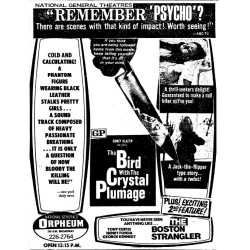
November 6, 1970 ad (Portland)
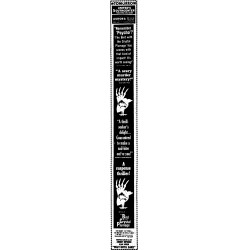
September 29, 1970 ad (Seattle)
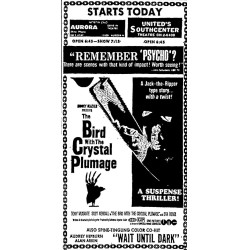
September 30, 1970 ad (Seattle)
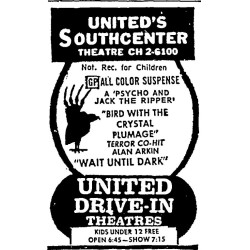
October 1, 1970 ad (Seattle)
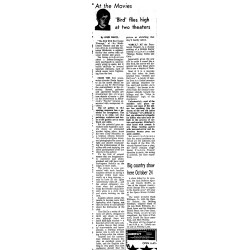
October 1, 1970 review (Seattle)
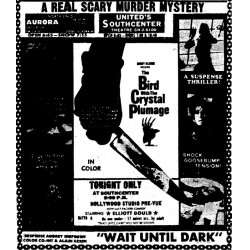
October 2, 1970 ad (Seattle)
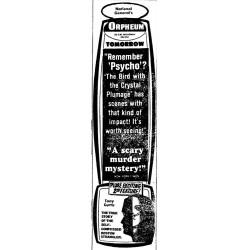
November 3, 1970 ad (Portland)
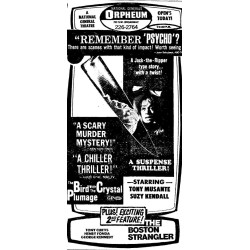
November 4, 1970 ad (Portland)
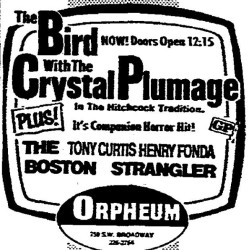
November 5, 1970 ad (Portland)
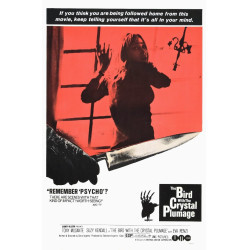
The Bird with the Crystal Plumage (1970) poster
The Bird with the Crystal Plumage (1970) trailer
Buy "The Bird with the Crystal Plumage" (1970) 4K UHD on Amazon (SPONSORED)
Buy "The Bird with the Crystal Plumage" (1970) bluray on Amazon (SPONSORED)
Buy "The Bird with the Crystal Plumage" (1970) DVD on Amazon (SPONSORED)
House of Dark Shadows (1970) in the PNW
- Details
- Written by: Mortado
- Category: The 1970s in Northwest Cinemas
- Hits: 417
This is a collection of media from the initial runs of "House of Dark Shadows" (1970) in the Pacific Northwest.
Click on images for larger versions.
House of Dark Shadows (1970)
“House of Dark Shadows” is one of those films that feels like it was dragged straight out of a fog-soaked graveyard and shoved onto the screen before anyone bothered to clean it up. It moves with the blunt confidence of something that already knows its audience is half converted, half doomed. The movie takes the gothic soap opera roots of its source material and squeezes them until only the pulp remains, trading the slow-burn melodrama for a more feral, blood-hungry rhythm. Everything is heightened, but not in a graceful, operatic way. It’s more like watching a desperate revival of old vampire theatrics, performed by people who understand that subtlety is a luxury they don’t have time for.
The atmosphere is thick with that particular early seventies gloom, where every mansion corridor seems to sweat secrets, and every character looks like they’re one bad night away from collapsing under the weight of their own anxieties. The film doesn’t bother pretending its world is anything but corruptible. It leans into the rot. The vampire at its center isn’t so much a tragic romantic figure as a predator who’s grown tired of hiding behind velvet curtains. There’s a certain charm in how unapologetically the story embraces its own darkness, refusing to soften the edges or offer moral comfort. It’s a universe where innocence is just bait, and everyone is too busy clutching their own fears to notice the walls closing in.
Visually, it has that unmistakable soap opera stiffness, but the roughness works in its favor. The camera lingers a little too long, the lighting is a little too stark, and the performances teeter between theatrical and exhausted. All of it creates a strange, uneasy texture, as if the limitations of its production haunt the film itself. That tension gives it a kind of accidental authenticity. You don’t watch “House of Dark Shadows” for polish. You watch it because it feels like a relic from a time when horror didn’t need to be clever or self-aware. It just needed to sink its teeth in and leave a mark.
The result is a film that’s messy, moody, and strangely compelling. It doesn’t pretend to be profound. It doesn’t try to reinvent anything. It simply commits to its own grim pulse, dragging the viewer through a story where desperation and desire blur together until you’re not sure whether the characters are fighting for their lives or just clinging to whatever scraps of meaning they can find. It’s rough, it’s cynical, and it’s absolutely drenched in atmosphere, the kind that sticks to you long after the credits roll.
Director: Dan Curtis
Writers: Sam Hall, Gordon Russell
Stars: Jonathan Frid, Grayson Hall, Kathryn Leigh Scott
Buy "House of Dark Shadows" (1970) bluray on Amazon (SPONSORED)
Buy "House of Dark Shadows" (1970) DVD on Amazon (SPONSORED)
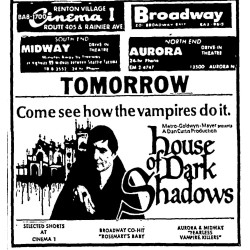
September 22, 1970 ad (Seattle)
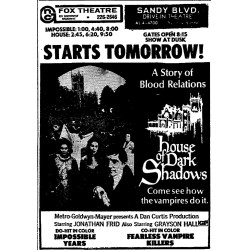
September 15, 1970 ad (Portland)
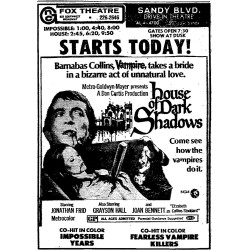
September 16, 1970 ad (Portland)
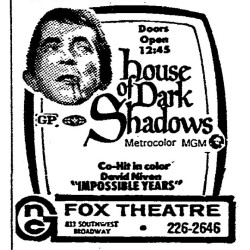
September 17, 1970 ad (Portland)
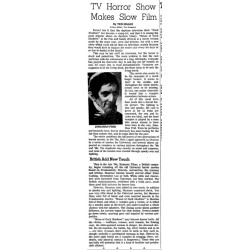
September 18, 1970 review (Portland)
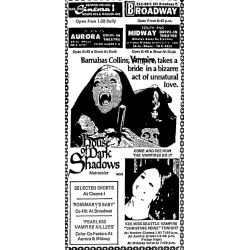
September 23, 1970 ad (Seattle)
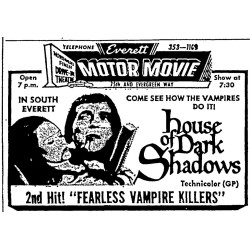
September 25, 1970 ad (Seattle)
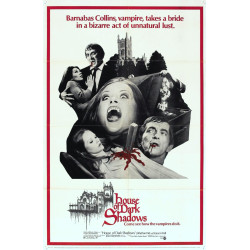
House of Dark Shadows (1970) poster
House of Dark Shadows (1970) trailer
Buy "House of Dark Shadows" (1970) bluray on Amazon (SPONSORED)
Buy "House of Dark Shadows" (1970) DVD on Amazon (SPONSORED)
Page 5 of 8