This is a collection of media from various movies, representing the closest things to grindhouse cinemas that Seattle and Portland had. Nudies, roughies, and the occasional art film ruled the day at these places. We'll have several more pages of these for this year.
Click on images for larger versions.

Hot Spur (1968)
“Hot Spur” (1968) is a strange, unruly hybrid of Western iconography and grindhouse provocation, a film that treats the frontier not as a mythic landscape but as a pressure cooker where desire, violence, and power constantly collide. Rather than following the clean moral lines of traditional Westerns, it plunges into a world where every character seems driven by impulse rather than principle, creating a narrative that feels volatile, unpredictable, and deliberately abrasive.
At its core, the film revolves around a ranching family whose internal tensions erupt when an outsider intrudes—an intrusion that becomes the catalyst for a chain of escalating confrontations. The story unfolds with a kind of feverish intensity, less concerned with plot mechanics than with the psychological and physical dominance games its characters play. The film’s protagonist is a figure defined by raw impulse, someone whose actions blur the line between rebellion and cruelty. His presence destabilizes the already fragile social order of the ranch, exposing buried resentments and unspoken hierarchies.
Stylistically, “Hot Spur” leans into its low-budget roots, using stark interiors, rough-hewn editing, and a restless camera to create a sense of confinement and agitation. The ranch house becomes a battleground of wills, its isolated setting amplifying the characters’ emotional volatility. The film’s tone veers between grim seriousness and a kind of lurid theatricality, creating an atmosphere that feels both claustrophobic and strangely hypnotic. Its use of Western tropes—horses, open land, the rugged individualist—serves mainly as a backdrop for a story that is far more intimate and confrontational than the genre typically allows.
Director: Lee Frost
Writers: Bob Cresse, Lee Frost
Stars: James Arena, Virginia Gordon, Joseph Mascolo
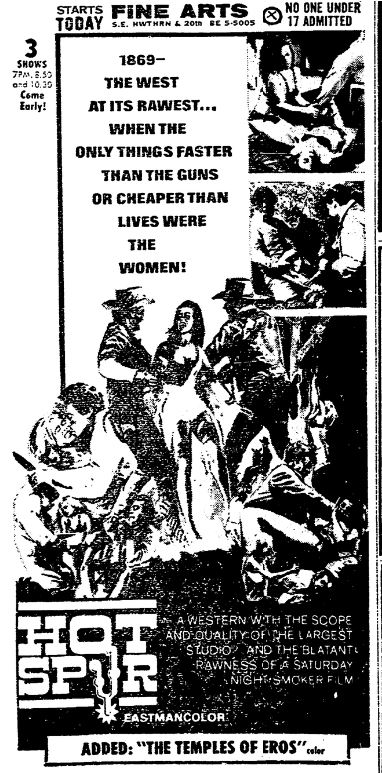
January 15, 1969 ad (Portland)
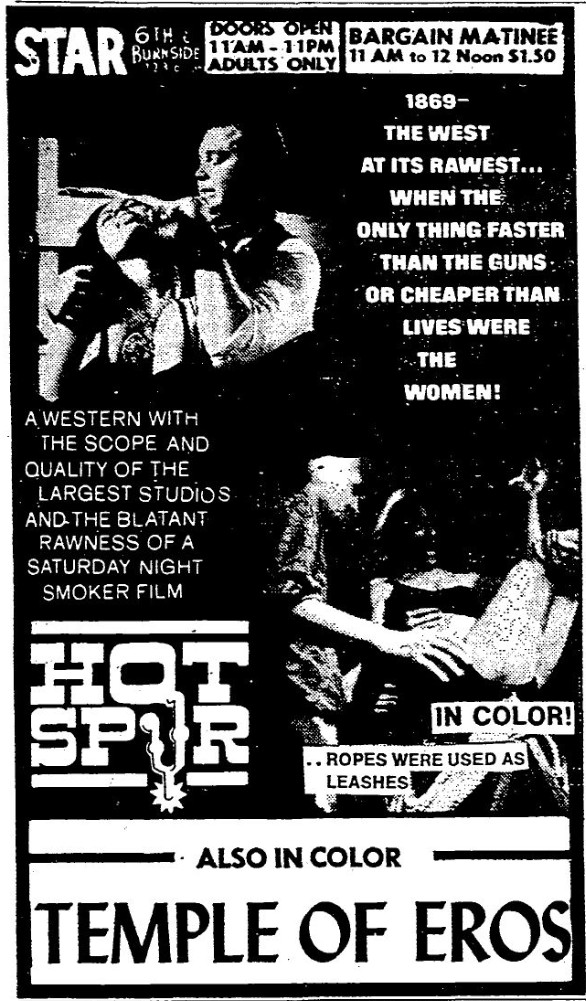
July 19, 1969 ad (Portland)
A Sweet Sickness (1968)
“A Sweet Sickness” (1968) is a moody, low‑budget character study that uses the framework of exploitation cinema to explore the emotional drift and moral dislocation of a young woman caught between desire, dependency, and the illusion of control. Rather than relying on shock value alone, the film builds its tension through the slow, uneasy unraveling of its protagonist’s inner life, presenting her not as a caricature of vice but as someone shaped by loneliness, economic precarity, and the seductive pull of people who promise escape but offer only further entanglement.
The film follows a woman whose life is defined by a series of unstable relationships—romantic, transactional, and aspirational. She moves through these spaces with a mix of vulnerability and performative confidence, trying to craft an identity that will shield her from the world’s indifference. What makes her compelling is the way the film refuses to simplify her motivations. She is neither a femme fatale nor a passive victim; instead, she is someone improvising her way through a life that keeps narrowing around her, clinging to fantasies of upward mobility even as the reality around her grows more claustrophobic.
Visually, “A Sweet Sickness” leans into the aesthetics of late‑1960s independent filmmaking: cramped interiors, handheld camerawork, and a grainy texture that gives the film a documentary‑like immediacy. This rawness becomes part of its emotional landscape. The environments she inhabits—dingy apartments, cheap bars, anonymous rooms—feel like extensions of her psyche, places where dreams curdle into resignation. The film’s pacing mirrors her drifting state, moving in fits and starts, lingering on moments of quiet desperation before plunging into scenes charged with tension or impulsive decision‑making.
Director: Jon Martin
Writer: G. Foy
Stars: Vincene Wallace, Art T. Romans, Vicki Carbe
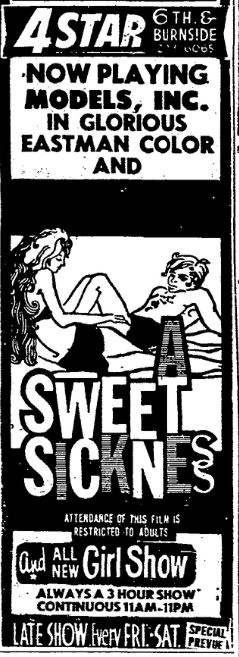
April 2, 1969 ad (Portland)
The Sexploiters (1965) - Note the blacked out first S in the title.
“The Sexploiters” (1965) is a sly, rough‑edged satire of ambition and desire wrapped in the trappings of mid‑sixties exploitation cinema. Rather than presenting its world of modeling, nightlife, and hustled glamour as a straightforward den of vice, the film treats it as a kind of feverish marketplace where everyone is selling something—image, affection, access, or the illusion of success. What emerges is a portrait of a culture obsessed with surfaces, where the pursuit of visibility becomes both a lure and a trap.
At the center of the film is a young woman drawn into the orbit of people who promise opportunity but operate according to their own appetites. She is not depicted as naïve so much as hopeful, someone who believes she can navigate a predatory environment through charm, adaptability, and a willingness to reinvent herself. The film’s tension comes from watching her negotiate a world where power is fluid and often transactional, where alliances shift quickly, and where the line between empowerment and exploitation is constantly blurred. Her journey becomes a study in how ambition can be shaped—and distorted—by the people who claim to offer guidance.
Stylistically, “The Sexploiters” reflects the aesthetics of early New York–based independent filmmaking: cramped apartments, makeshift studios, and urban streets that feel both vibrant and indifferent. The handheld camerawork and unpolished lighting give the film a documentary immediacy, as though the viewer is eavesdropping on a subculture that thrives in the shadows of mainstream respectability. This rawness is not merely a budgetary limitation; it reinforces the film’s themes by grounding its characters in a world where glamour is always provisional and often illusory.
Director: Al Ruban
Stars: Norma Berke, Bettina, Joann Brier

April 23, 1969 ad (Portland)
Hollywood's World of Flesh (1963)
“Hollywood’s World of Flesh” (1963) is a tawdry, self‑conscious peek behind the curtain of the entertainment industry, using the grammar of early‑sixties exploitation cinema to expose the gap between Hollywood’s shimmering façade and the transactional reality beneath it. Rather than offering a straightforward exposé, the film constructs a feverish, semi‑documentary portrait of a world where glamour is both a commodity and a trap, and where the pursuit of fame becomes inseparable from the surrender of autonomy.
The film orbits around a young woman drawn into the machinery of show business, a figure whose aspirations are shaped as much by cultural mythmaking as by personal desire. She enters Hollywood imagining opportunity, but what she encounters is a labyrinth of gatekeepers, opportunists, and self‑styled impresarios who treat ambition as a resource to be mined. Her journey becomes a study in disillusionment, not because she is naïve, but because the system itself is designed to blur the line between empowerment and exploitation. The film’s tension lies in watching her navigate a landscape where every promise carries an unspoken cost, and where visibility is granted only to those willing to play by rules they did not create.
Stylistically, “Hollywood’s World of Flesh” leans into the raw immediacy of low‑budget filmmaking. Its grainy cinematography, cramped interiors, and abrupt editing rhythms create a sense of voyeurism, as though the viewer is witnessing scenes not meant for public consumption. The film’s pseudo‑documentary tone amplifies this effect, giving its depiction of casting calls, photo shoots, and industry parties an unsettling authenticity. Hollywood is presented not as a dream factory but as a marketplace of bodies and personas, a place where identity is endlessly reshaped to meet the demands of those in power..
Director: Lee Frost
Stars: Baby Bubbles, Robin James, Gaby Martone
Massacre of Pleasure (1966)
“Massacre of Pleasure” (1966) is a jagged, disquieting entry in mid‑sixties exploitation cinema, a film that uses its lurid title as a provocation while delivering something more psychologically charged than its marketing suggests. Rather than relying solely on sensationalism, it constructs a portrait of a subculture driven by appetite, ego, and the illusion of liberation, revealing how quickly the pursuit of pleasure can curdle into manipulation and emotional corrosion. The film’s world is one where desire is treated as currency, and where the characters’ attempts to escape boredom or insignificance only deepen their entanglement in cycles of exploitation.
At the center of the story is a charismatic but hollow figure who presides over a loose circle of thrill‑seekers, artists, and hangers‑on. His influence is less about authority than about the gravitational pull of someone who embodies the era’s fantasies of freedom while masking a profound emptiness. The people around him—particularly the young women drawn into his orbit—are searching for meaning, connection, or transformation, but the film shows how easily those longings can be redirected toward self‑destructive ends. Their interactions unfold with a mix of seduction and menace, creating a tone that oscillates between bohemian spontaneity and emotional claustrophobia.
Stylistically, “Massacre of Pleasure” embraces the raw textures of low‑budget filmmaking: handheld camerawork, dim interiors, and abrupt edits that give the film a restless, almost documentary quality. This aesthetic reinforces the sense that the viewer is witnessing a world that thrives on instability. Parties, loft gatherings, and nighttime wanderings are shot not as glamorous escapes but as rituals of distraction, places where the characters attempt to outrun their own dissatisfaction. The film’s pacing mirrors this atmosphere, drifting through moments of languid hedonism before snapping into scenes charged with tension or moral reckoning.
Director: Jean-Pierre Bastid
Writers: Jean-Pierre Bastid, Guy Freising, Chris Pentel
Stars: Joël Barbouth, Pierre Cabanne, Beatrice Cenci
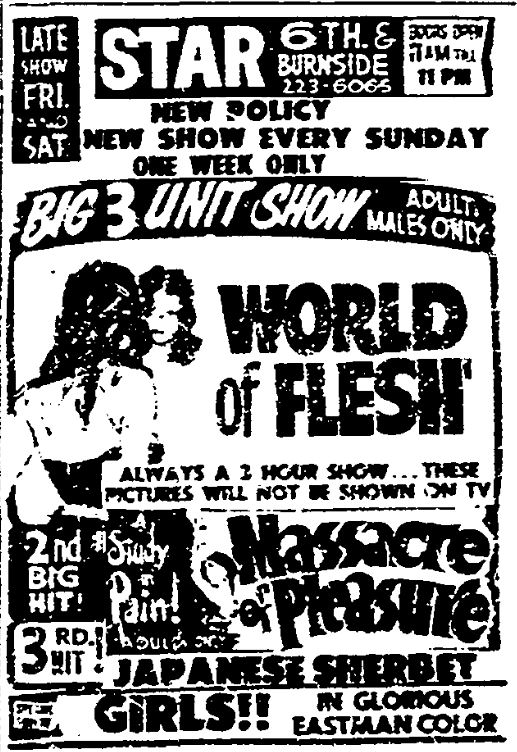
April 30, 1969 ad (Portland)
