This is a collection of media from various movies, representing the closest things to grindhouse cinemas that Seattle and Portland had. Nudies, roughies, and the occasional art film ruled the day at these places.
Click on images for larger versions.
Inga (1968)
“Inga” (1968) may wear the soft, pastel glow of Scandinavian respectability, but underneath that polished surface beats a far rougher, more mercenary heart. The film pretends to offer a gentle coming‑of‑age story, yet what it really delivers is a slow, methodical stripping away of a young woman’s illusions as she’s fed into the machinery of adult desire. Everyone around her speaks in the language of culture, refinement, and opportunity, but their actions betray a far simpler motive: they want access to her youth, her pliability, her usefulness. The film’s cynicism comes from how casually this predation is normalized, as though exploitation were simply another rite of passage.
Inga herself is caught in a bind that the film never lets her escape: she’s curious enough to step into the adult world but inexperienced enough to misread every signal. Her attempts at independence only tighten the net around her, because the people guiding her aren’t mentors—they’re opportunists dressed in sophistication. The film’s rough edge comes from how bluntly it exposes this dynamic. It doesn’t romanticize her awakening; it shows how easily innocence becomes a bargaining chip in a world where power flows to those who speak with confidence and take without asking.
Visually, “Inga” is all soft lighting and idyllic exteriors, but that beauty functions like bait. The warm interiors feel less like safe havens and more like traps upholstered in good taste. The camera lingers on moments that should feel tender but instead carry a faint chill, as though the film itself is warning the viewer not to trust the elegance of its own images. The contrast between the film’s aesthetic gentleness and its emotional brutality is what gives it its bite.
Ultimately, “Inga” is a story about a society eager to congratulate itself for embracing modernity while still clinging to the oldest power structures imaginable. It celebrates liberation with one hand and enforces obedience with the other. The film’s rough cynicism lies in its refusal to pretend otherwise. Inga’s journey isn’t framed as a triumph or a tragedy—it’s simply the cost of being young, desirable, and surrounded by people who mistake vulnerability for opportunity.
Director: Joseph W. Sarno
Writer: Joseph W. Sarno
Stars: Marie Liljedahl, Monica Strömmerstedt, Thomas Ungewitter
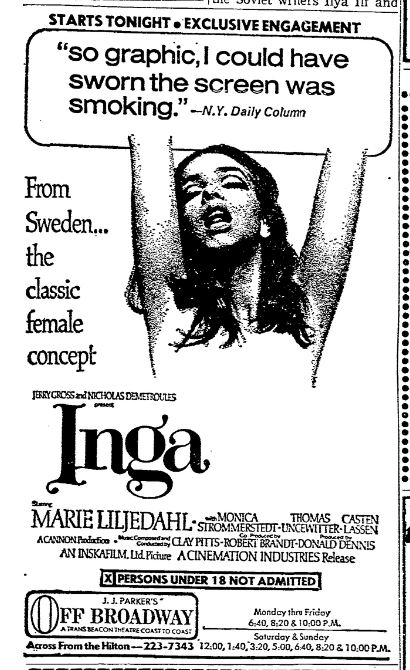
May 7, 1969 ad (Portland)
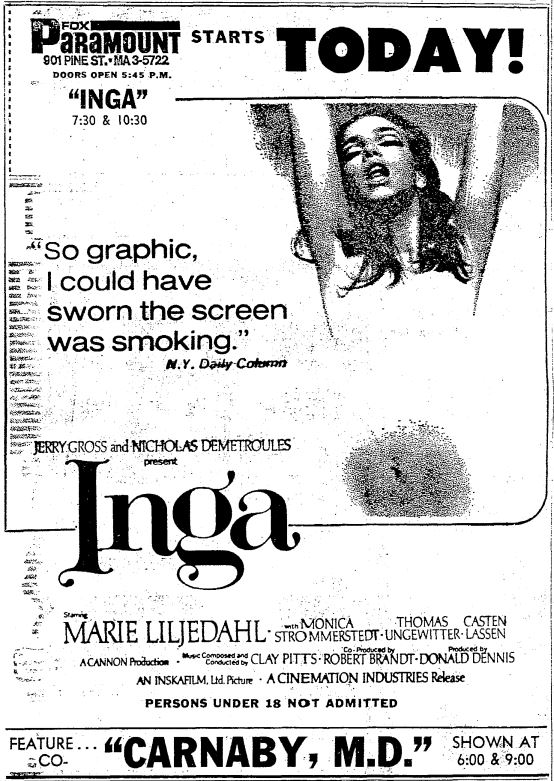
June 11, 1969 ad (Seattle)
Babes in the Woods (1962)
“Babes in the Woods” (1962) is the kind of low‑budget morality tale that pretends to warn its audience about youthful recklessness while clearly reveling in every bad decision it puts on screen. The film dresses itself up as a cautionary fable, but its real interest lies in watching a group of young adults stumble through a world they’re convinced they understand, only to reveal—again and again—how little they actually grasp. It’s a story about naïveté colliding with opportunism, and the resulting mess is presented with a tone that’s equal parts judgmental and fascinated.
At its center is a pair of young women who head into the world with more confidence than experience, believing that independence is simply a matter of leaving home and acting worldly. The film wastes no time showing how quickly that illusion crumbles. Every encounter they have—whether with self‑styled sophisticates, would‑be protectors, or people who simply see them as entertainment—underscores how unprepared they are for the games adults play. The cynicism comes from how the film frames these interactions: not as tragic missteps, but as inevitable consequences of stepping outside the boundaries society has drawn for them. It’s less a narrative of growth than a slow, uncomfortable education in how easily innocence can be misread as availability.
Stylistically, “Babes in the Woods” has the rough, unvarnished look of early‑sixties exploitation filmmaking. Its cramped interiors, abrupt edits, and flat lighting give the impression of a world that’s both small and unforgiving. The film’s attempts at glamour feel half‑hearted, as though even it doesn’t fully believe in the fantasies it’s selling. This visual plainness becomes part of its critique: the world the characters chase is never as exciting or liberating as they imagine, and the camera refuses to dress it up.
Director: A.A. Krovek
Writer: Edmund Kerwin
Stars: Louise Downe, Marge London, Karen Moore

May 21, 1969 ad (Portland)
The Satanist (1968)
“The Satanist” (1968) is one of those grubby, late‑sixties occult quickies that pretends to be a window into forbidden rites but is really more interested in exposing the rot beneath suburban respectability. The film dresses itself in the trappings of mystique—shadowy gatherings, whispered invocations, a sense of transgression—but its real engine is the quiet desperation of people who feel their lives slipping into monotony and will latch onto anything, even the absurd, to feel powerful again. It’s less a supernatural thriller than a portrait of spiritual bankruptcy wearing a devil mask.
At the center is a man whose life has become so numbing that even the slightest hint of danger feels like salvation. His fascination with a mysterious neighbor isn’t driven by belief so much as boredom; he’s the kind of person who mistakes any disruption for meaning. The film’s cynicism comes from how easily he’s drawn in—not because the occult is seductive, but because he’s already hollowed out enough to be seduced by anything. The people he encounters in this supposed underworld aren’t dark prophets or sinister masterminds; they’re petty manipulators, using ritual as a smokescreen for their own appetites and insecurities. The “satanic” trappings are less about cosmic evil and more about giving small people a sense of grandeur.
Visually, “The Satanist” has that unmistakable low‑budget grindhouse texture: dim rooms, awkward zooms, and a camera that seems to be trying to convince the audience it’s seeing something dangerous when the sets look like they were borrowed from a neighbor’s basement. But that roughness becomes part of the film’s charm. The cheapness underscores the emptiness of the characters’ pursuits—these aren’t people communing with ancient forces; they’re adults playing dress‑up because real life has nothing left to offer them. The film’s attempts at atmosphere feel strained, which only makes its underlying bleakness more apparent.
Director: Zoltan G. Spencer
Writer: Zoltan G. Spencer
Stars: Pat Barrington, Mary Bauer
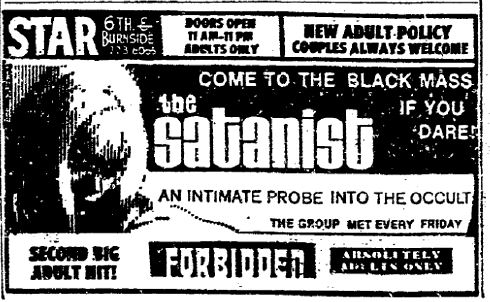
June 4, 1969 ad (Portland)
Michael and Helga (1968)
“Michael and Helga” (1968) is one of those late‑sixties European melodramas that pretends to be a study of passion and emotional awakening but is, at its core, a fairly bleak dissection of two people using each other to fill the voids they refuse to acknowledge. The film wraps itself in the soft‑focus sensuality typical of the era, yet the story beneath that gauzy veneer is anything but tender. It’s a portrait of two damaged individuals mistaking intensity for intimacy, and the result is a relationship that feels less like romance and more like a slow‑motion collision.
Michael is the kind of man who believes brooding silence counts as depth, drifting through life with the air of someone convinced the world has wronged him without ever examining how much of his misery is self‑inflicted. Helga, meanwhile, is caught in her own cycle of longing and self‑deception, drawn to Michael not because he offers stability or affection but because he represents a break from the suffocating predictability of her life. Their connection is built on projection rather than understanding, and the film’s cynicism comes from how clearly it shows this while still letting the characters pretend otherwise.
The roughness of the film lies in its refusal to romanticize the emotional messiness it depicts. Every moment that might have been tender is undercut by the sense that both characters are performing for each other, trying to mold themselves into whatever version of desire they think will keep the other from leaving. The camera lingers on their faces not to capture intimacy but to expose the cracks—hesitations, doubts, and the unmistakable awareness that neither of them is getting what they actually need. The film’s aesthetic softness becomes a kind of trap, luring the viewer into expecting warmth while delivering something far colder.
Director: Erich F. Bender
Writers: Erich F. Bender, Roland Caemmerer, Klaus E.R. von Schwarze
Stars: Ruth Gassmann, Felix Franchy, Elfi Rüter

June 11, 1969 ad (Portland)
2069 A.D. (1969)
“2069 A.D.” (1969) is the kind of bargain‑basement futurism that promises a bold vision of tomorrow but mostly delivers a grimy, leering snapshot of late‑sixties anxieties dressed up in tinfoil and pseudo‑philosophy. It’s a film that claims to be peering a century ahead, yet it can’t see past the cultural hang‑ups of its own era. The future it imagines is less a technological leap than a convenient excuse to strip away social restraints and call it prophecy. What results is a world supposedly liberated from old moral codes, but the film’s cynicism is obvious: liberation here is just exploitation with better lighting.
The story orbits around a society that has supposedly evolved beyond traditional relationships, yet everything about this future feels hollow and performative. The characters drift through sterile environments and ritualized encounters, convinced they’re participating in some enlightened new order when they’re really just acting out the same old power dynamics under a different banner. The film’s rough edge comes from how bluntly it exposes this contradiction. Its future is populated by people who talk about progress but behave like they’re trapped in an endless loop of boredom, vanity, and emotional vacancy.
Visually, “2069 A.D.” is a patchwork of cheap sets, minimalist décor, and the kind of “futuristic” costuming that looks like it was assembled from whatever the production designer found on clearance. But the cheapness ends up working in the film’s favor. The stark, empty rooms and repetitive imagery make the future feel not advanced but drained—stripped of warmth, connection, and purpose. The film’s attempts at sophistication only highlight how artificial everything is, as if the future has been reduced to a series of staged tableaux meant to distract from the absence of anything meaningful underneath.
What ultimately defines “2069 A.D.” is its bleak view of human progress. The film suggests that no matter how far society claims to evolve, people will still chase the same shallow pleasures, still mistake novelty for fulfillment, and still cling to systems that promise freedom while quietly enforcing conformity. Its cynicism lies in the idea that the future won’t save anyone from themselves; it will just give them new ways to dress up the same old emptiness. And its roughness comes from refusing to pretend otherwise. This is a future where humanity hasn’t ascended—it’s just found a sleeker way to stagnate.
Director: Sam Kopetzky
Writer: Robert Faust
Stars: Harvey Shain, Barbara Lynn, Sharon Matt

June 25, 1969 ad (Portland)
