This is a collection of media from various movies, representing the closest things to grindhouse cinemas that Seattle and Portland had. Nudies, roughies, and the occasional art film ruled the day at these places. This will be the last of these collections for this year.
Click on images for larger versions.
The Pleasure Machines (1969)
“The Pleasure Machines” (1969) is one of those late‑sixties countercultural knockoffs that pretends to diagnose society’s moral decay while clearly enjoying every minute of it. The film wraps itself in the language of futurism and social critique, but beneath the surface, it’s really just a cynical parade of people mistaking indulgence for enlightenment. It imagines a world where technology and liberation have supposedly merged into some grand new human experience, yet everything about this future feels cheap, hollow, and designed by people who think “progress” means removing consequences rather than confronting them.
At the center of the film is a group of characters who drift through this so‑called advanced society with the vacant confidence of people convinced they’re living on the cutting edge. They talk about freedom, innovation, and self‑actualization, but their actions reveal a far simpler truth: they’re bored, aimless, and desperate for anything that might distract them from their own emptiness. The machines themselves—marketed as tools of pleasure, transformation, or expanded consciousness—are really just props that allow the characters to avoid facing the emotional voids they carry. The film’s rough edge comes from how bluntly it exposes this contradiction, even if it never admits that’s what it’s doing.
Visually, “The Pleasure Machines” has all the hallmarks of low‑budget futurism: minimalist sets that look like repurposed office space, lighting that tries to be avant‑garde but mostly feels like a power outage, and costuming that mistakes oddity for imagination. But the cheapness ends up reinforcing the film’s cynicism. This future isn’t sleek or visionary—it’s a flimsy stage built to disguise how little has actually changed. The characters may be surrounded by gadgets and rhetoric about liberation, but they’re still trapped in the same cycles of manipulation, vanity, and self‑delusion that defined the decade’s more grounded dramas.
Director: Ronald Víctor García
Writer: Ronald Víctor García
Stars: Frederick Norseman, Barbara Lynn, Perry Dell
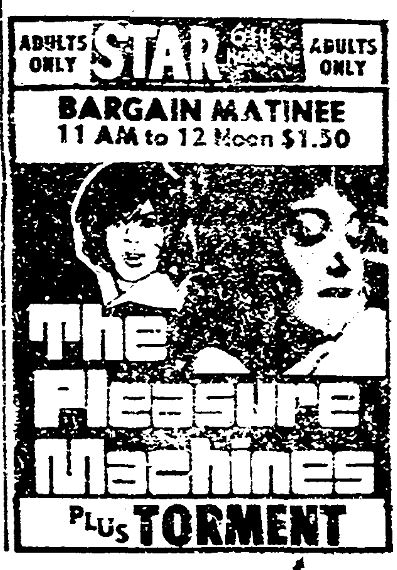
July 2, 1969 ad (Portland)
Brand of Shame (AKA "Nude Django," 1968)
“Brand of Shame” (1969) is one of those late‑sixties exploitation dramas that pretends to be a moral inquiry into corruption and desire but is really a bruised, cynical look at how easily people surrender their dignity when the world offers them even the faintest glimmer of escape. The film operates in that familiar grindhouse register where every character is either running from something, selling something, or pretending they’re in control of a situation that’s already devouring them. It’s a story about people who think they’re navigating a system, only to discover they’re the ones being processed by it.
At the center is a young woman whose life is shaped less by choices than by circumstances tightening around her like a vise. She’s pushed, coaxed, and manipulated by people who talk about opportunity but really mean ownership. The film’s roughness comes from how bluntly it exposes this dynamic: every gesture of kindness has strings attached, every promise of advancement is just another trap, and every supposed ally is really just another opportunist waiting for their turn. The cynicism isn’t subtle—this is a world where vulnerability is a commodity and shame is something imposed, not earned.
Visually, “Brand of Shame” has that unmistakable late‑sixties grindhouse texture: dim rooms, cheap sets, and a camera that lingers just long enough to make the viewer uncomfortable. The environments feel cramped and airless, as though the film wants to remind you that its characters have nowhere to go. Even the moments that hint at glamour or liberation are shot with a kind of weary resignation, as if the film itself knows these fantasies won’t survive the next scene. The aesthetic isn’t pretty, but it’s honest about the world it’s depicting.
What ultimately defines the film is its bleak understanding of power. “Brand of Shame” suggests that the real cruelty of exploitation isn’t the violence or the manipulation—it’s the way it convinces people that this is the best they can hope for. The characters cling to illusions because the truth is too suffocating to face, and the film never lets them forget it. It’s a story that doesn’t offer redemption or catharsis, only the grim recognition that some systems are designed to break people and then blame them for the damage.
Director: Byron Mabe
Writers: Gene Radford, David F. Friedman
Stars: Steve Stunning, Cara Peters, Steve Vincent
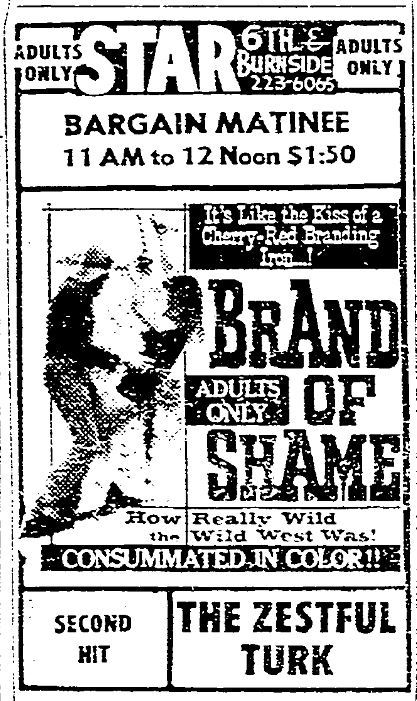
July 23, 1969 ad (Portland)
Space Thing (1968)
“Space Thing” (1968) is one of those threadbare sci‑fi sexploitation relics that pretends to be a cosmic adventure while barely bothering to hide that it’s really just a cheap motel room with aluminum foil taped to the walls. It’s a film that claims to explore intergalactic conflict and futuristic societies, yet everything about it—from the cardboard sets to the half‑awake performances—betrays a production more interested in ogling than imagining. The result is a movie that feels less like a journey into the unknown and more like a late‑night dare that somehow made it to distribution.
The story follows an alien infiltrator who boards a spaceship populated entirely by women, a premise that tells you everything about the film’s priorities. The supposed mission, diplomacy, and interstellar stakes are all window dressing for a parade of awkward seductions and stilted encounters. The film’s cynicism comes from how shamelessly it uses the sci‑fi label as a shield, as if calling something “the future” excuses the fact that nothing in this world functions, behaves, or even looks remotely futuristic. The characters drift through scenes with the dazed energy of people who know they’re trapped in a production that can’t afford a second take.
Visually, “Space Thing” is a masterclass in low‑effort futurism. Costumes look like they were scavenged from a thrift store’s clearance bin, props wobble if you breathe near them, and the spaceship interiors resemble a basement rec room decorated by someone who misunderstood the concept of “space age.” But this roughness ends up amplifying the film’s accidental honesty. The future it presents isn’t sleek or visionary—it’s a flimsy fantasy built by people who think a few blinking lights can distract from the emptiness underneath.
What ultimately defines “Space Thing” is its bleakly funny view of human (and alien) desire. The film suggests, perhaps unintentionally, that no matter how far civilization advances, people will still be driven by the same shallow impulses, still fall for the same cheap illusions, and still mistake novelty for meaning. Its rough edge comes from its refusal—or inability—to pretend otherwise. In this universe, space isn’t a frontier of discovery; it’s just another backdrop for the same old games of ego, lust, and delusion.
Directors: Byron Mabe, David F. Friedman
Writer: Cosmo Politan
Stars: Karla Conway, Steve Vincent, Merci Montello
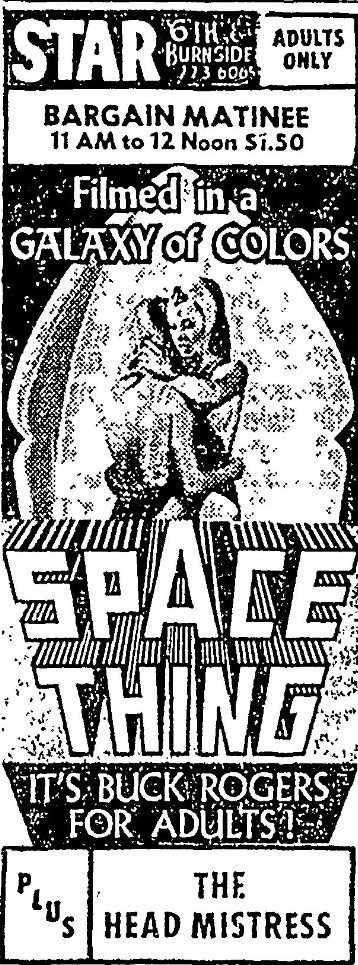
July 25, 1969 ad (Portland)
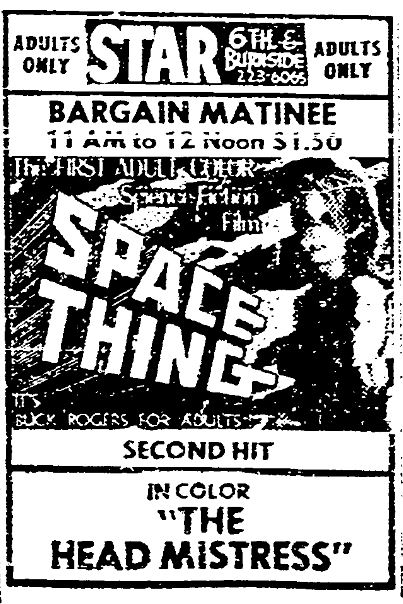
July 30, 1969 ad (Portland)
Love Camp 7 (1969)
“Love Camp 7” (1969) is a film built on shock value, and even then, it can’t quite disguise how threadbare and hollow its ambitions really are. It presents itself as a hard‑hitting wartime drama, but beneath the uniforms and grim pronouncements lies a production far more interested in provocation than perspective. The film’s supposed seriousness is a thin coat of paint over a story that treats human suffering as a stage prop, using the backdrop of conflict not to explore anything meaningful but to justify a parade of cruelty dressed up as narrative necessity. Its roughness isn’t a stylistic choice—it’s the byproduct of a film that mistakes exploitation for boldness.
At the center of the story are two women sent undercover into a camp that claims to be a strategic hub but functions more like a grim caricature of oppression. Their mission is framed as noble, but the film’s cynicism is obvious: it’s far more invested in their degradation than their espionage. Every scene that could have carried tension or emotional weight is instead twisted into an excuse to showcase the worst impulses of the genre. The authority figures they encounter aren’t characters so much as blunt instruments—cartoonishly cruel, theatrically corrupt, and devoid of any nuance that might complicate the film’s single‑minded fixation on suffering as spectacle.
Visually, “Love Camp 7” has the flat, washed‑out look of a production made quickly and cheaply, with sets that feel assembled from whatever was lying around and lighting that seems allergic to subtlety. The film’s attempts at atmosphere fall apart under the weight of its own excesses. Instead of dread, it generates a kind of weary resignation, as though even the camera knows it’s documenting something that has no interest in coherence or craft. The roughness of the imagery mirrors the roughness of the storytelling—both are blunt, graceless, and uninterested in anything beyond immediate impact.
Director: Lee Frost
Writers: Bob Cresse, Wes Bishop
Stars: Bob Cresse, Maria Lease, Kathy Williams
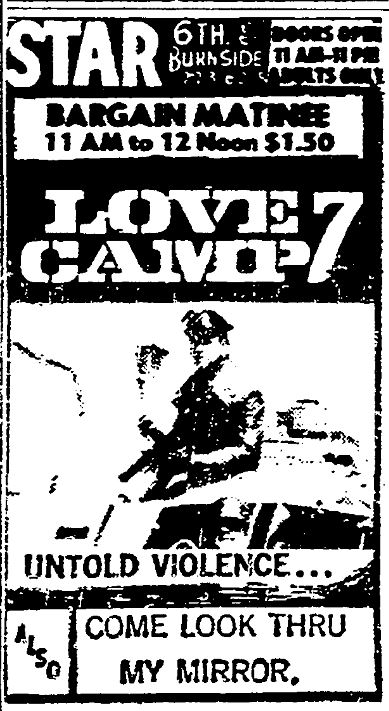
October 22, 1969 ad (Portland)
The Gun Runner (1969)
“The Gun Runner” (1969) is the sort of down‑and‑dirty crime drama that pretends to be about high‑stakes smuggling but is really a study in how small, desperate men convince themselves they’re operating on some grand geopolitical stage. The film follows its titular antihero through a world of back‑alley deals, double‑crosses, and half‑baked schemes, all of which he approaches with the swagger of someone who thinks he’s a major player when he’s barely keeping his head above water. Its cynicism comes from how clearly it shows the gap between the myth he’s selling and the reality he’s drowning in.
The protagonist is a man who mistakes recklessness for courage and self‑interest for strategy. He moves through the criminal underworld with the confidence of someone who’s never bothered to consider the consequences of his actions, and the film never lets him forget it. Every alliance he forms is built on sand, every opportunity is a trap disguised as a shortcut, and every moment of triumph is undercut by the sense that he’s one misstep away from being swallowed whole. The roughness of the film lies in its refusal to romanticize this life; it shows smuggling not as a glamorous hustle but as a grind powered by paranoia, ego, and the constant fear of being outplayed.
Visually, “The Gun Runner” has the gritty, sun‑bleached look of late‑sixties low‑budget crime cinema. The locations feel transient and unstable—cheap motels, dusty roads, anonymous border towns—mirroring the protagonist’s own rootlessness. The camera lingers on the weariness etched into every face, as though the film wants to make sure the audience understands that no one in this world is winning. Even the action scenes feel stripped‑down and exhausted, more like desperate scrambles than heroic showdowns.
What ultimately defines “The Gun Runner” is its bleak understanding of ambition. The film suggests that the criminal underworld isn’t populated by masterminds or visionaries but by men who cling to the illusion of control because the alternative is admitting they’re trapped. Its cynicism lies in its portrayal of a world where loyalty is a bargaining chip, trust is a liability, and survival depends on how convincingly you can pretend you’re not afraid. Its roughness comes from its honesty: this isn’t a story about rising through the ranks—it’s about sinking slowly while insisting you’re climbing.
Director: Richard Compton
Writer: Richard Compton
Stars: Trent Dolan, Vicki Carbe, John Rico

October 31, 1969 ad (Portland)
