Home
Trog/Taste the Blood of Dracula (1970) in the PNW
- Details
- Written by: Mortado
- Category: The 1970s in Northwest Cinemas
- Hits: 219
This is a collection of media from the initial runs of "Trog" and "Taste the Blood of Dracula" (1970) in the Pacific Northwest.
Click on images for larger versions.
Trog (1970)
“Trog” is one of those late-career curiosities that feels less like a film and more like a stubborn refusal to admit the party ended decades ago. Joan Crawford, still carrying herself with the brittle dignity of someone who once ruled Hollywood, wanders through a cheap British creature feature as if she has been dropped into the wrong production and is determined to pretend otherwise. The movie itself is a strange collision of scientific earnestness and drive in theatrics, stitched together with the kind of production design that looks like it was scavenged from whatever happened to be lying around the studio that week.
The creature, Trog, is presented with the solemnity of a breakthrough discovery, yet everything about him screams rubber mask and desperation. The film tries to sell him as a tragic evolutionary leftover, but the execution leans toward a man in a suit who wandered away from a carnival sideshow. Crawford’s character treats him like a misunderstood specimen, speaking to him with the clipped authority of someone who has spent too many years commanding scenes that deserved better scripts. Her performance is oddly compelling precisely because she refuses to acknowledge how absurd the whole thing is. She plays it straight, almost defiantly, as though sheer force of will could elevate the material. It doesn’t, but watching her try is its own spectacle.
The tone swings between pseudo-scientific lectures and bursts of chaos that feel engineered to remind the audience that, yes, this is supposed to be a monster movie. The supporting cast behaves as if they are trapped in a moral panic about the dangers of letting anything unfamiliar exist within a five-mile radius. Their hysteria is meant to contrast with Crawford’s icy professionalism, but it mostly exposes how thin the film’s ideas are. It wants to say something about fear, progress, and the fragile boundary between humanity and its past, yet it never musters the conviction to explore any of it.
“Trog” ends up being a relic of a relic, a film that clings to old star power while drowning in cheap sensationalism. It is fascinating in the way abandoned amusement parks are fascinating: not because they were great, but because you can still see the bones of what they tried to be. If anything, the film’s greatest achievement is its unintentional portrait of a declining industry, with Crawford standing in the middle of it, refusing to go quietly.
Director: Freddie Francis
Writers: Aben Kandel, Peter Bryan, John Gilling
Stars: Joan Crawford, Michael Gough, Bernard Kay
Buy "Trog" (1970) bluray on Amazon (SPONSORED)
Buy "Trog" (1970) DVD on Amazon (SPONSORED)
Taste the Blood of Dracula (1970)
“Taste the Blood of Dracula” is one of those Hammer entries where the studio’s old gothic machinery keeps grinding along even after the gears have rusted, and the result is a film that feels both desperate and strangely compelling. It opens with the usual Victorian piety, all stiff collars and moral posturing, but you can sense the rot underneath from the start. The men who claim to uphold society’s virtues are exactly the ones itching to crawl into the gutter, and the film wastes no time showing how quickly their polished respectability curdles once they’re given a chance to indulge themselves. It’s less a story about Dracula than it is about the pathetic human need to feel powerful, and how easily that need can be exploited.
When Dracula finally enters the picture, he’s less a character than a consequence. The film treats him like a kind of moral boomerang: these men summon him out of their own cowardice and vanity, and then act shocked when he behaves like the embodiment of everything they tried to hide. Christopher Lee plays him with that familiar cold disdain, as though he’s tired of being resurrected by idiots. The violence he brings isn’t grand or operatic; it’s almost perfunctory, like he’s cleaning up a mess someone else made. The real horror comes from watching supposedly upright citizens unravel the moment their reputations are threatened, revealing that Dracula’s darkness isn’t supernatural at all—it’s just human weakness with fangs.
The younger generation in the film is treated with the usual Hammer ambivalence: they’re naïve enough to be prey, but they’re also the only ones who seem capable of seeing through the hypocrisy choking their parents. Their rebellion isn’t romantic or noble; it’s more like a weary refusal to participate in the same hollow rituals. The film uses them as a kind of moral counterweight, though not in a sentimental way. They’re simply less invested in the lies that keep the older men upright, which makes them the only ones with any chance of surviving the fallout.
Visually, the movie leans into Hammer’s trademark mix of lush color and claustrophobic interiors. Everything feels slightly overripe, as though the sets themselves are decaying. The production design does most of the thematic heavy lifting, framing the story as a slow suffocation inside velvet curtains and candlelit parlors. It’s a world that looks expensive but feels cheap, which is exactly the point. The film’s cynicism is baked into its aesthetic: beauty as a mask, tradition as a trap, and Dracula as the inevitable result of pretending everything is fine.
Director: Peter Sasdy
Writers: Anthony Hinds
Stars: Christopher Lee, Geoffrey Keen, Gwen Watford
Buy "Taste the Blood of Dracula" (1970) bluray on Amazon (SPONSORED)
Buy "Taste the Blood of Dracula" (1970) DVD on Amazon (SPONSORED)
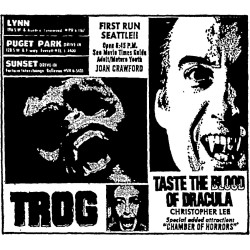
September 30, 1970 ad (Seattle)
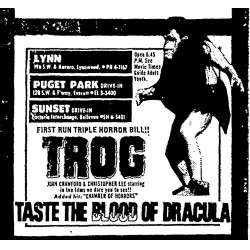
October 1, 1970 ad (Seattle)
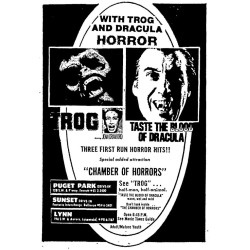
October 2, 1970 ad (Seattle)
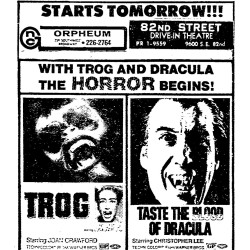
October 6, 1970 ad (Portland)
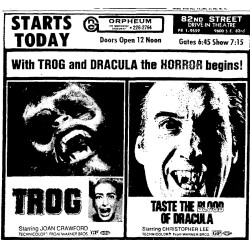
October 7, 1970 ad (Portland)
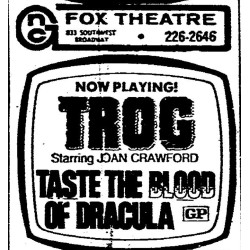
October 8, 1970 ad (Portland)
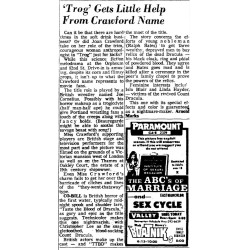
October 9, 1970 review (Portland)
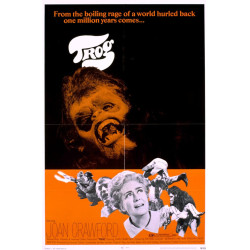
Trog (1970) poster
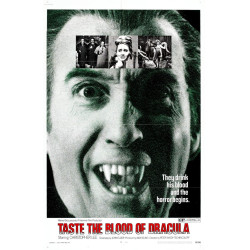
Taste the Blood of Dracula (1970) poster
Trog (1970) trailer
Buy "Trog" (1970) bluray on Amazon (SPONSORED)
Buy "Trog" (1970) DVD on Amazon (SPONSORED)
Taste the Blood of Dracula (1970) trailer
Buy "Taste the Blood of Dracula" (1970) bluray on Amazon (SPONSORED)
Buy "Taste the Blood of Dracula" (1970) DVD on Amazon (SPONSORED)
Weekend with the Babysitter (1970) in the PNW
- Details
- Written by: Mortado
- Category: The 1970s in Northwest Cinemas
- Hits: 210
This is a collection of media from the initial runs of "Weekend with the Babysitter" (1970) in the Pacific Northwest.
Click on images for larger versions.
Weekend with the Babysitter (1970)
“Weekend with the Babysitter” is one of those limp late-era exploitation curios where you can practically smell the cigarette smoke of the producers hovering over every frame. It pretends to be a cautionary tale about suburban rot, but it's really just an excuse to parade a middle-aged man’s midlife fantasies under the guise of moral inquiry. The film follows a drifting father who seems bored with his own life, bored with his wife, bored with the dull rituals of domesticity, and the babysitter becomes the convenient spark that lets him imagine he is still capable of rebellion. What passes for plot is mostly an excuse to shove him into situations where he can feel dangerous again, though the danger is always sanitized, safe, and designed to flatter him rather than expose anything real.
The movie gestures toward counterculture anxieties, but it never commits. It wants the thrill of youth culture without the bite, so everything feels like a staged reenactment of rebellion rather than the thing itself. The babysitter is less a character than a prop, a symbol of freedom that the film never bothers to understand. She drifts through scenes with the kind of vague innocence exploitation films love to pretend is subversive. The father’s crisis, meanwhile, is treated with a straight face, as though his self-pity were profound rather than tedious. The film keeps insisting he is trapped by society, but it is obvious he is only trapped by his own vanity.
What makes “Weekend with the Babysitter” interesting, if at all, is the accidental honesty that leaks through its cheap surfaces. You see a culture terrified of aging, terrified of irrelevance, terrified of the youth it claims to celebrate. The film wants to be daring, but it is too timid to confront the ugliness of its own premise. Instead, it settles for a soft-focus fantasy where consequences never land, and desire is treated like a harmless hobby. It is a relic of a moment when Hollywood tried to cash in on counterculture without understanding it, and the result is a movie that feels both sleazy and strangely hollow, a rebellion performed by people who never actually left the suburbs.
Director: Don Henderson
Writers: James E. McLarty, George E. Carey, Don Henderson
Stars: George E. Carey, Susan Romen, James Almanzar
Buy "Weekend with the Babysitter" (1970) DVD on Amazon (SPONSORED)
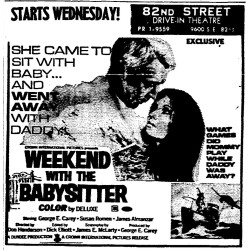
September 29, 1970 ad (Portland)
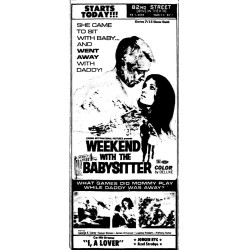
September 30, 1970 ad (Portland)
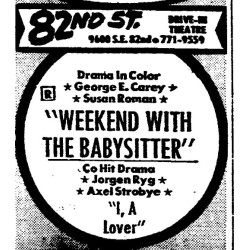
October 1, 1970 ad (Portland)
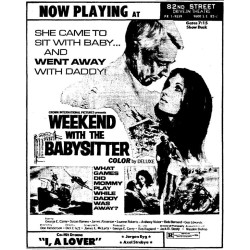
October 2, 1970 ad (Portland)
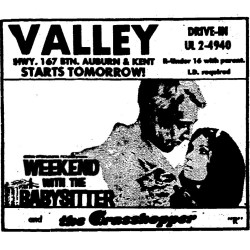
October 20, 1970 ad (Seattle)
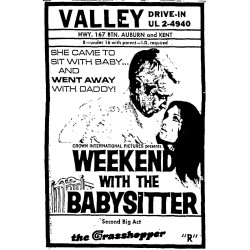
October 21, 1970 ad (Seattle)
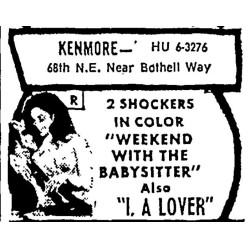
October 22, 1970 ad (Seattle)
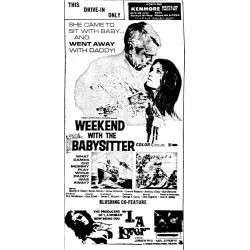
October 24, 1970 ad (Seattle)
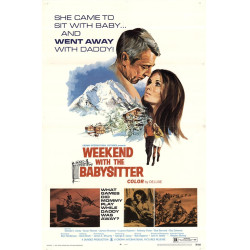
Weekend with the Babysitter (1970) poster
Weekend with the Babysitter (1970) trailer
Buy "Weekend with the Babysitter" (1970) DVD on Amazon (SPONSORED)
Page 3 of 8