Home
Good Morning... and Goodbye! (1967)/The Wild Pussycat (1969) in the PNW
- Details
- Written by: Mortado
- Category: The 1970s in Northwest Cinemas
- Hits: 525
This is a collection of media from the initial runs of "Good Morning... and Goodbye!" and "The Wild Pussycat" in the Pacific Northwest.
Click on images for larger versions.
Good Morning... and Goodbye! (1967)
“Good Morning... and Goodbye!” is one of those Russ Meyer fever dreams where suburban malaise curdles into something both pathetic and strangely operatic. The film staggers through its story like a drunk trying to convince you he’s sober, all bright colors and sweaty closeups masking the fact that everyone on screen is spiritually bankrupt. It’s a domestic farce stretched until it frays, a portrait of middle-aged desperation where lust is treated like a last-ditch survival instinct rather than a pleasure. Meyer shoots the whole thing with that trademark mix of cartoonish exaggeration and grim sincerity, as if he’s daring you to laugh at people who are clearly circling the drain.
The characters drift through their routines with a kind of hollow determination, clinging to affairs, fantasies, and self-help nonsense because the alternative is admitting their lives never amounted to much. The film’s world is sun-drenched but suffocating, a place where every attempt at reinvention looks cheap and every promise of renewal feels like a con. Meyer’s editing gives everything a jittery, restless pulse, as though the movie itself is trying to escape the claustrophobic boredom of its characters. What emerges is a cynical little morality play about the delusions people build to avoid confronting their own insignificance.
It’s not subtle, and it’s not trying to be. “Good Morning... and Goodbye!” is a blunt instrument, a sweaty, over-lit snapshot of American dissatisfaction dressed up as a sex comedy. But beneath the noise and the leering bravado, there’s a bleak honesty about how people flail when they realize their lives have stalled. Meyer doesn’t offer redemption, only the grim spectacle of people mistaking chaos for change. It’s messy, loud, and strangely human in its ugliness.
Director: Russ Meyer
Writer: Jackie Moran
Stars: Alaina Capri, Stuart Lancaster, Patrick Wright
The Wild Pussycat (1969)
“The Wild Pussycat” is one of those late sixties Greek exploitation curiosities that pretends to be a revenge thriller but mostly wallows in its own sleaze. The film moves with a kind of grim determination, as if it knows it doesn’t have the budget, the polish, or the moral compass to be anything respectable, so it leans into the grime instead. Everything feels slightly off-kilter: the acting is stiff in that way only regional cinema can manage, the dialogue sounds like it was translated twice before being spoken, and the whole production has the jittery energy of people trying to make something “bold” without fully understanding what that means.
At its core, the film is a study in obsession, but not the romantic kind. It’s the kind of obsession that festers, that turns people into caricatures of their worst impulses. “The Wild Pussycat” treats emotional damage like a performance, lingering on faces that look both numb and furious, as if the characters are trapped in their own private purgatories. The camera seems almost predatory, hovering over bodies and expressions with a voyeuristic hunger that makes the film feel more like a feverish confession than a narrative. There’s a sense that everyone involved is trying to exorcise something, but they’re doing it with cheap lighting, cramped interiors, and a script that keeps circling the same dark impulses.
The film’s cynicism is baked into every frame. It doesn’t believe in redemption, or justice, or even catharsis. It believes in cruelty as a kind of cosmic inevitability. The world of “The Wild Pussycat” is small, claustrophobic, and ruled by people who mistake domination for strength. Even its attempts at eroticism feel hollow, like the film is trying to distract you from how bleak its worldview really is. What emerges is a rough-edged, unsettling little artifact of sixties exploitation cinema, a reminder that sometimes the most revealing films are the ones that don’t bother pretending to be anything other than damaged.
Director: Dimis Dadiras
Writer: Giannis Tziotis
Stars: Kostas Prekas, Gisela Dali, Maria Foka
Buy "The Wild Pussycat" (1969) bluray on Amazon (SPONSORED)
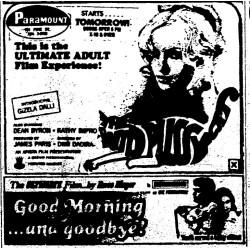
September 15, 1970 ad (Seattle)
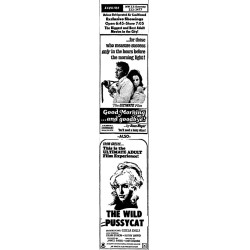
August 5, 1970 ad (Portland)
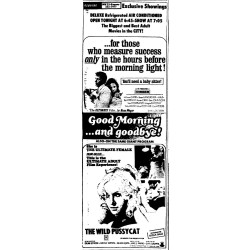
August 6, 1970 ad (Portland)
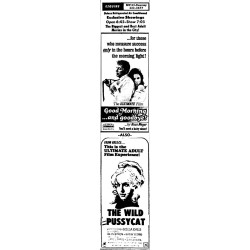
August 7, 1970 ad (Portland)
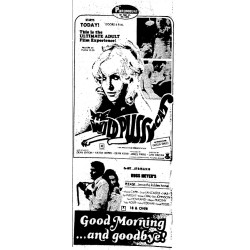
September 16, 1970 ad (Seattle)
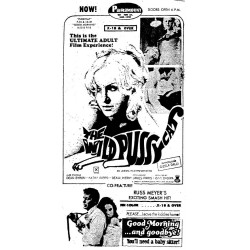
September 18, 1970 ad (Seattle)
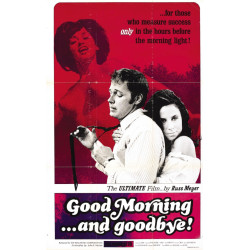
Good Morning... and Goodbye! (1967) poster
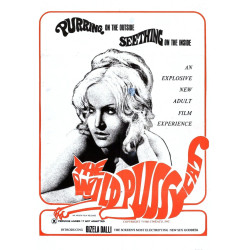
The Wild Pussycat (1969) poster
Female Animal/The Man from O.R.G.Y. (1970) in the PNW
- Details
- Written by: Mortado
- Category: The 1970s in Northwest Cinemas
- Hits: 423
This is a collection of media from the initial runs of "Female Animal" and "The Man from O.R.G.Y." (both 1970) in the Pacific Northwest.
Click on images for larger versions.
Female Animal (1970)
“Female Animal” is one of those downbeat late-era exploitation curios where the sun-drenched setting only makes the rot underneath more obvious. The film drifts through its story with the kind of languid, slightly grimy confidence that tells you it was never trying to impress anyone. It’s a portrait of people circling each other out of boredom, vanity, and a faint hope that desire might briefly distract them from the emptiness they drag around. The plot is simple enough, but the mood is what sticks: a kind of resigned sleaze, the feeling of a world where everyone is performing a version of themselves they stopped believing in years ago.
The central dynamic is built on the illusion of control. The older woman at the center moves through her life as though she’s still the one holding the reins, but every gesture feels like a bluff. The younger man she fixates on isn’t a romantic figure so much as a mirror reflecting her fear of fading relevance. Their connection isn’t tender or tragic; it’s transactional in the way only human longing can be when both parties know they’re using each other. The film never pretends otherwise. It lets the audience sit with the discomfort, the awkwardness, the quiet humiliation that comes from wanting something you can’t quite name.
What gives “Female Animal” its bite is how casually it exposes the emotional dead zones people build around themselves. The characters talk, flirt, argue, and posture, but none of it feels like communication. It’s more like static, the noise people make when they’re terrified of silence. The camera lingers on faces a beat too long, catching the moments when the performance slips and you see the exhaustion underneath. There’s no grand revelation, no moral lesson, no tidy arc. Just people drifting through a sunlit purgatory, clinging to desire because it’s the only thing that still feels real.
It’s a small film, but not a shallow one. Its cynicism isn’t flashy; it’s weary, lived in, the kind that comes from watching people repeat the same mistakes until they become habits. “Female Animal” doesn’t judge its characters, but it doesn’t pity them either. It simply observes them with a kind of rough honesty, letting their choices speak for themselves. In that sense, it’s more revealing than it initially appears. Beneath the exploitation veneer is a quiet, unsettling reminder of how easily people can mistake attention for affection, and how quickly desire curdles when it’s used as a shield against loneliness.
Director: Jerry Gross
Writers: Octavio Bellini, Marcelo Lazarino
Stars: Arlene Farber, Vassili Lambrinos, Andre Landzaat
The Man from O.R.G.Y. (1970)
“The Man from O.R.G.Y.” is one of those cheap, sunburned late sixties leftovers that somehow stumbled into 1970 still wearing the same smirk. It pretends to be a spy spoof, but really it’s just a long, lazy shrug dressed up as a movie. Everything about it feels half-awake, as if the production was powered by stale cigarettes and the vague hope that audiences would laugh simply because the premise sounded naughty. The film coasts on innuendo the way a broken-down car coasts downhill: momentum doing all the work, gravity supplying whatever passes for charm.
The so-called hero is less a character than a walking punchline, a man who seems permanently confused about whether he’s supposed to be suave or pathetic. The film never resolves that tension, and maybe it doesn’t care to. He wanders through the story like a man who took a wrong turn into someone else’s fantasy and decided to stay because the drinks were free. Every encounter feels transactional, every gag feels like it was written on a napkin during a lunch break, and every attempt at satire lands with the soft thud of a joke told by someone who doesn’t quite remember the setup.
What gives “The Man from O.R.G.Y.” its accidental charm is how nakedly it exposes the desperation of late-era sexploitation trying to keep up with a culture that had already moved on. The film wants to be daring, but it’s timid. It wants to be funny, but it’s tired. It wants to be risqué, but it’s stuck in a world where titillation is treated like a magic trick that no longer fools anyone. You can practically feel the flop sweat behind the camera, the anxious hope that a wink and a suggestive title might distract from the fact that the whole thing is running on fumes.
There’s a certain rough amusement in watching it try so hard. The cheap sets, the limp jokes, the strained performances all blend into a kind of accidental honesty. The film isn’t lying about what it is. It’s a relic of a moment when exploitation cinema was losing its edge and scrambling to reinvent itself, grasping at parody because sincerity was no longer selling. “The Man from O.R.G.Y.” ends up being less a comedy and more a snapshot of an industry caught between eras, clinging to old tricks while the world outside had already stopped paying attention.
Director: James Hill
Writer: Ted Mark
Stars: Robert Walker Jr, Steve Rossi, Slappy White
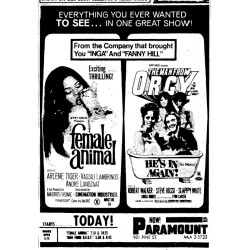
July 1, 1970 ad (Seattle)
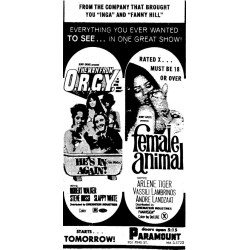
June 30, 1970 ad (Seattle)
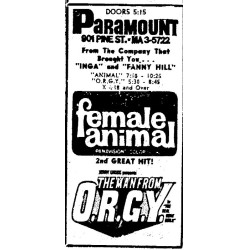
July 2, 1970 ad (Seattle)
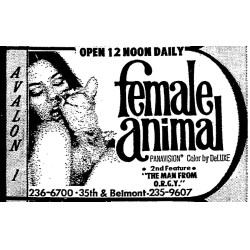
September 15, 1970 ad (Portland)
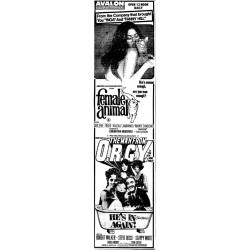
September 16, 1970 ad (Portland)
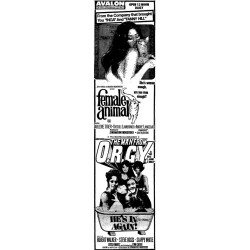
September 18, 1970 ad (Portland)
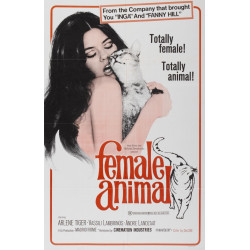
Female Animal (1970) poster
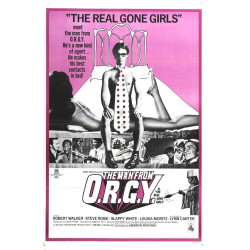
The Man from O.R.G.Y. (1970) poster
Page 8 of 8