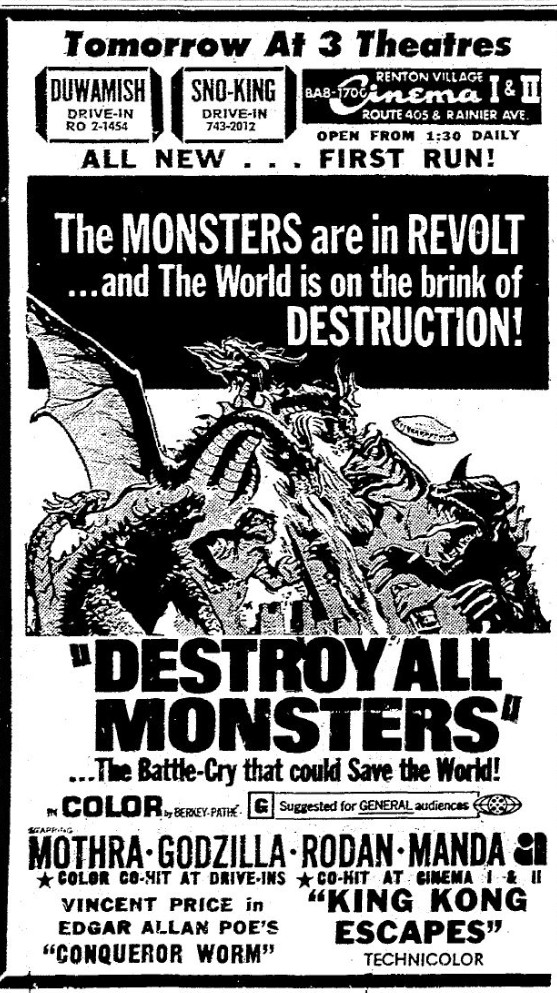
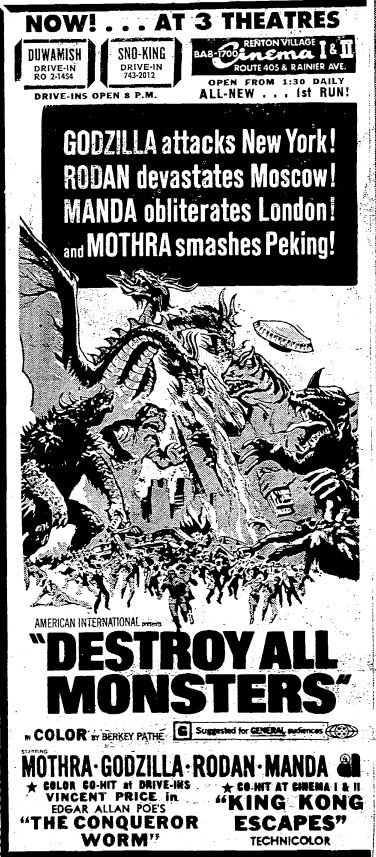
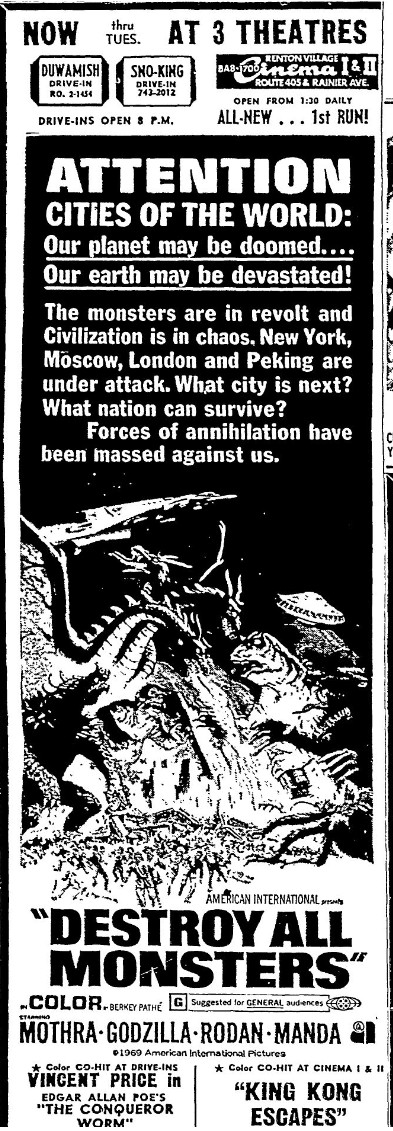
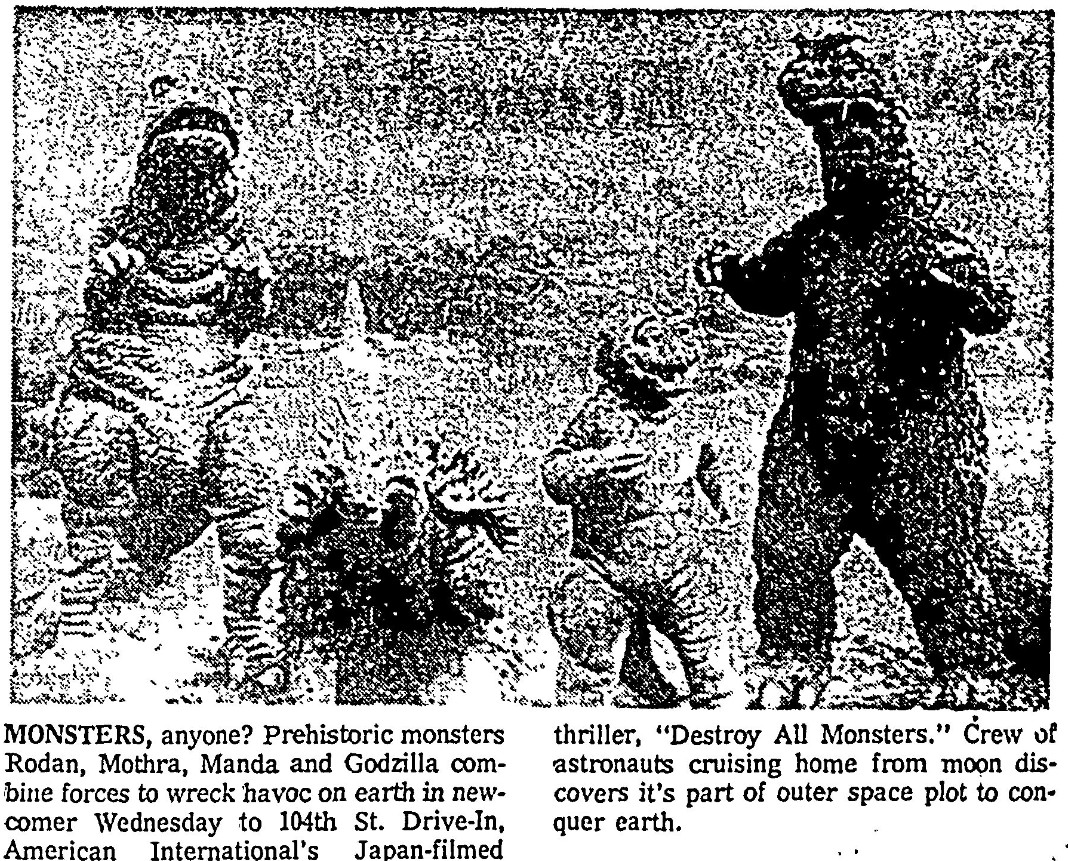
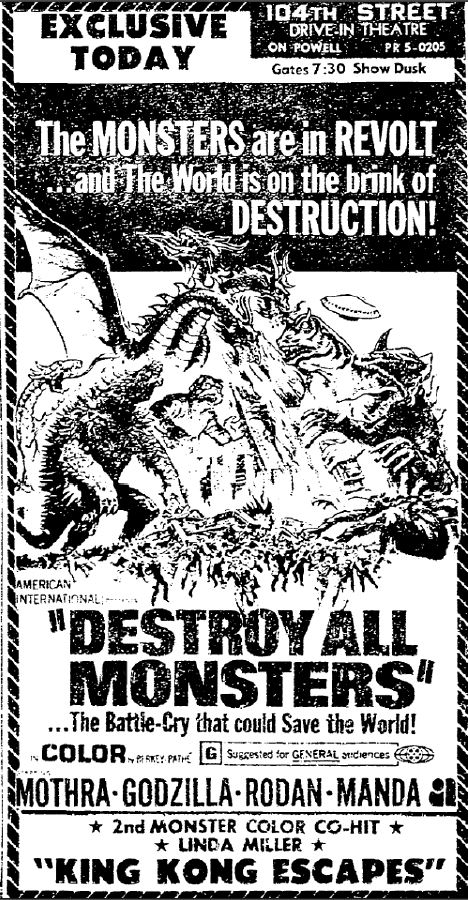
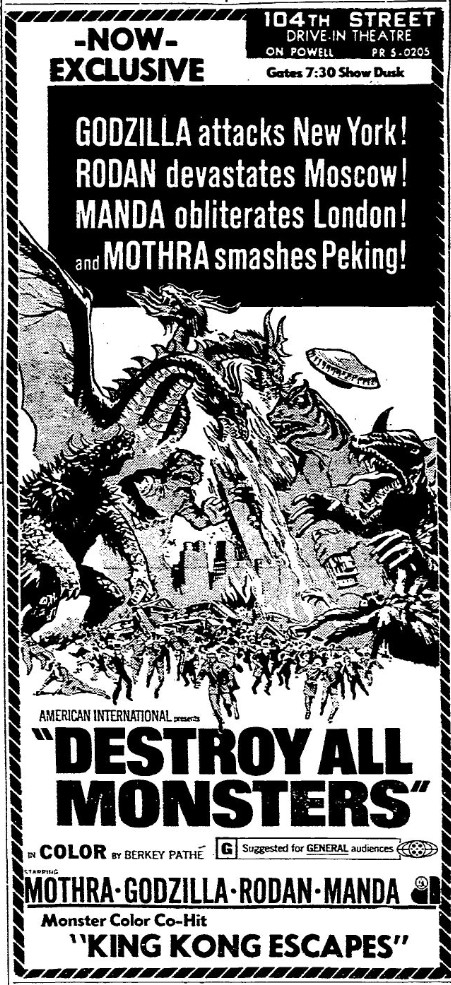
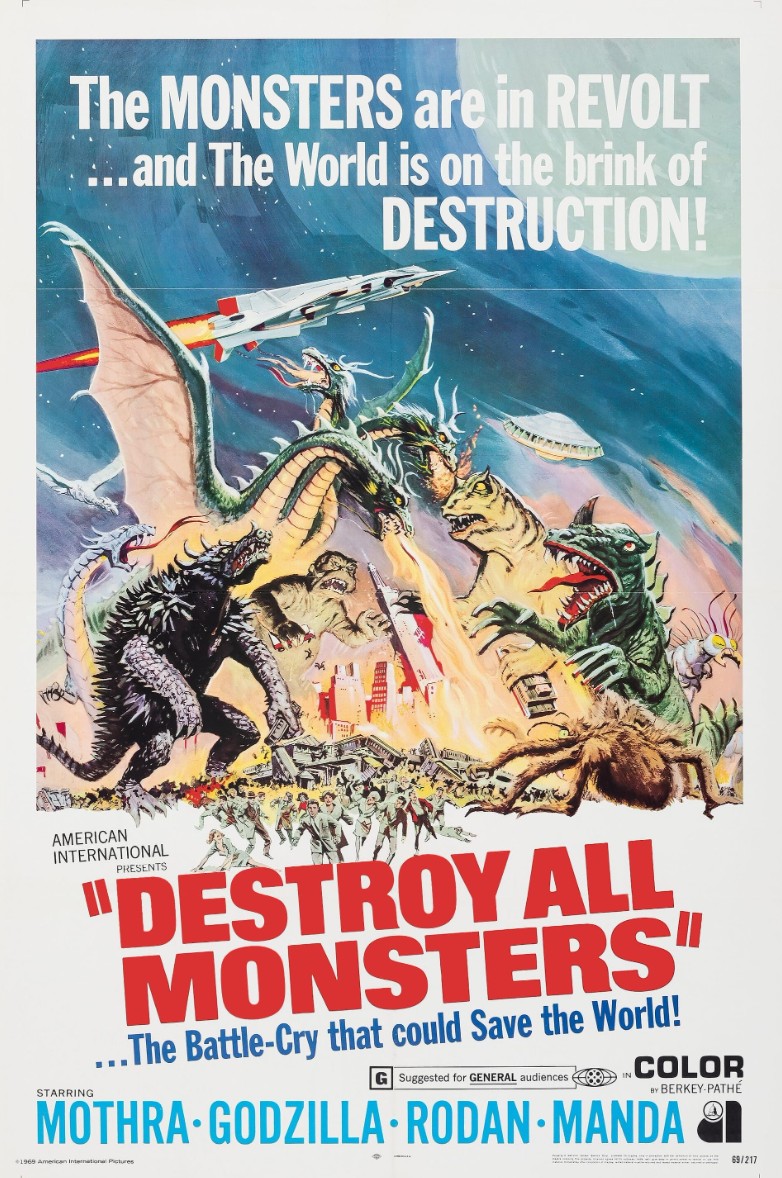
This is a collection of media from the initial runs of "Destroy All Monsters" (1968) in the Pacific Northwest. Depending on the venue, you would get either "King Kong Escapes" or "The Conqueror Worm" for a second feature.
Click on images for larger versions.
Destroy All Monsters (1968)
“Destroy All Monsters” arrives at a fascinating crossroads in the Godzilla franchise, a moment when Toho sought both to celebrate its expanding kaiju universe and to reassert its relevance amid shifting cinematic tastes. Drawing on the information from contemporary and retrospective accounts, the film positions itself as a kind of grand kaiju pageant, gathering nearly every major monster in Toho’s roster and staging them within a future world where humanity has achieved a tenuous peace. That peace is quickly ruptured, of course, but the film’s real interest lies less in narrative intricacy than in the spectacle and cultural texture that emerge from its premise.
The film imagines a late‑20th‑century Earth where the United Nations Science Committee has confined the monsters to Monsterland, a controlled habitat designed to neutralize their threat. This setup reflects a distinctly late‑1960s optimism about scientific management and global cooperation, even as it hints at anxieties about containment, surveillance, and the limits of human control. When an alien force—the Kilaaks—seizes control of both the island and the monsters, the story shifts into a hybrid of space‑age paranoia and international crisis drama, echoing the era’s fascination with extraterrestrial threats and Cold War infiltration narratives. The film’s human characters, including the crew of the Moonlight SY‑3, embody this forward‑looking technological confidence, navigating lunar missions and advanced monitoring systems with a matter‑of‑fact competence that mirrors the period’s enthusiasm for space exploration.
Visually, “Destroy All Monsters” functions as a culmination of Toho’s Showa‑era aesthetic. Ishirō Honda’s direction and Sadamasa Arikawa’s effects work emphasize scale, motion, and the tactile pleasure of miniature destruction, while Akira Ifukube’s score—praised for its “memorably booming” presence—anchors the film with a sense of mythic grandeur. The attacks on global capitals unfold with a rhythmic, almost ritualistic quality, each sequence showcasing a different monster’s personality and physical vocabulary. The film’s structure, which moves briskly from one set‑piece to another, reinforces its identity as a celebratory ensemble piece rather than a tightly plotted drama.
Critically, the film has undergone a notable reevaluation. While early American reviews were mixed, often focusing on its simplicity or dubbing quality, later audiences have embraced it as a high‑spirited convergence of kaiju mythology. Its "audacious and simple story” and “innovative action sequences” are now seen as strengths, allowing the film to operate as both a gateway for newcomers and a reward for longtime fans. It captures a transitional moment in the franchise—originally intended as the series’ finale—and channels that sense of culmination into a narrative that feels both expansive and strangely elegiac.
What makes “Destroy All Monsters” endure is not merely the quantity of creatures on display but the way it synthesizes the thematic currents of its time: the tension between global unity and external threat, the allure of technological mastery, and the persistent fantasy of nature’s titanic forces erupting beyond human control. It stands as a vibrant artifact of late‑1960s genre cinema, a film that revels in its own excess while offering a snapshot of the cultural imagination that produced it.
Directors: Ishirô Honda, Jun Fukuda
Writers: Ishirô Honda, Takeshi Kimura
Stars: Akira Kubo, Jun Tazaki, Yukiko Kobayashi
Buy "Destroy All Monsters" (1968) bluray on Amazon (SPONSORED)
Buy "Destroy All Monsters" (1968) DVD on Amazon (SPONSORED)




Destroy All Monsters (1968) trailer
Buy "Destroy All Monsters" (1968) bluray on Amazon (SPONSORED)
Buy "Destroy All Monsters" (1968) DVD on Amazon (SPONSORED)
