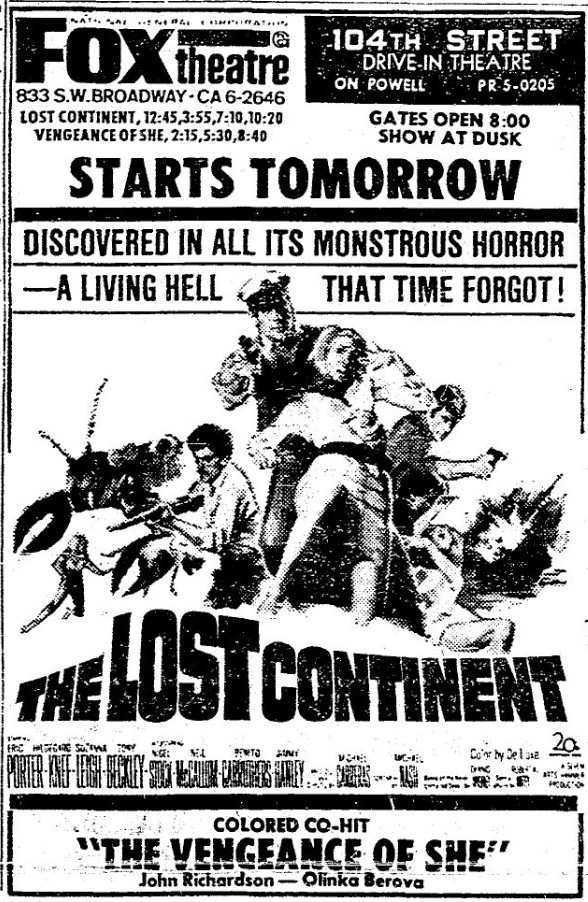
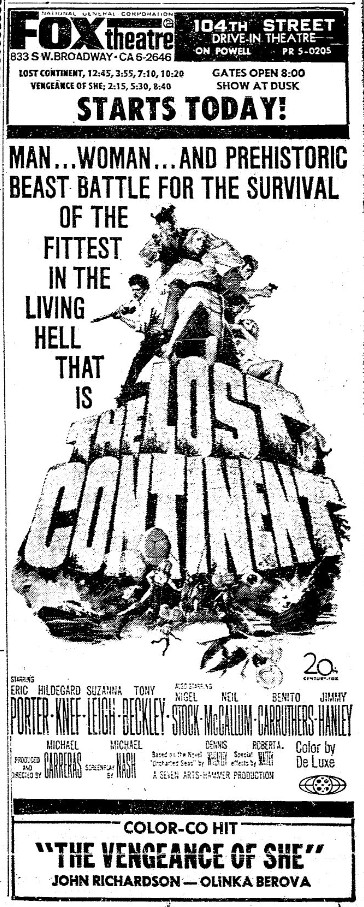
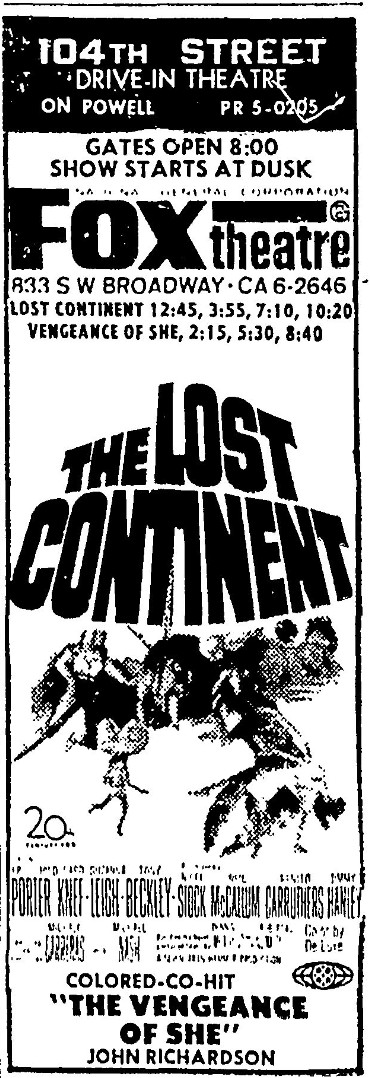
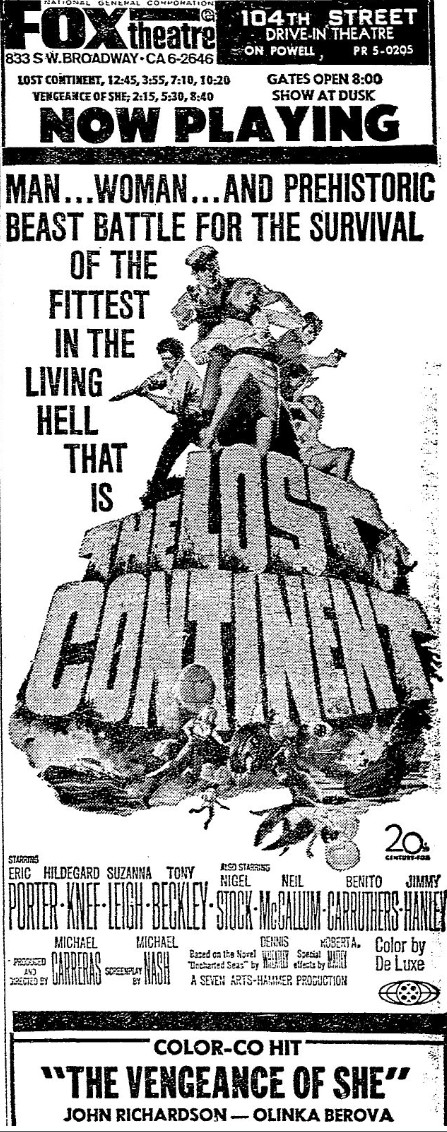
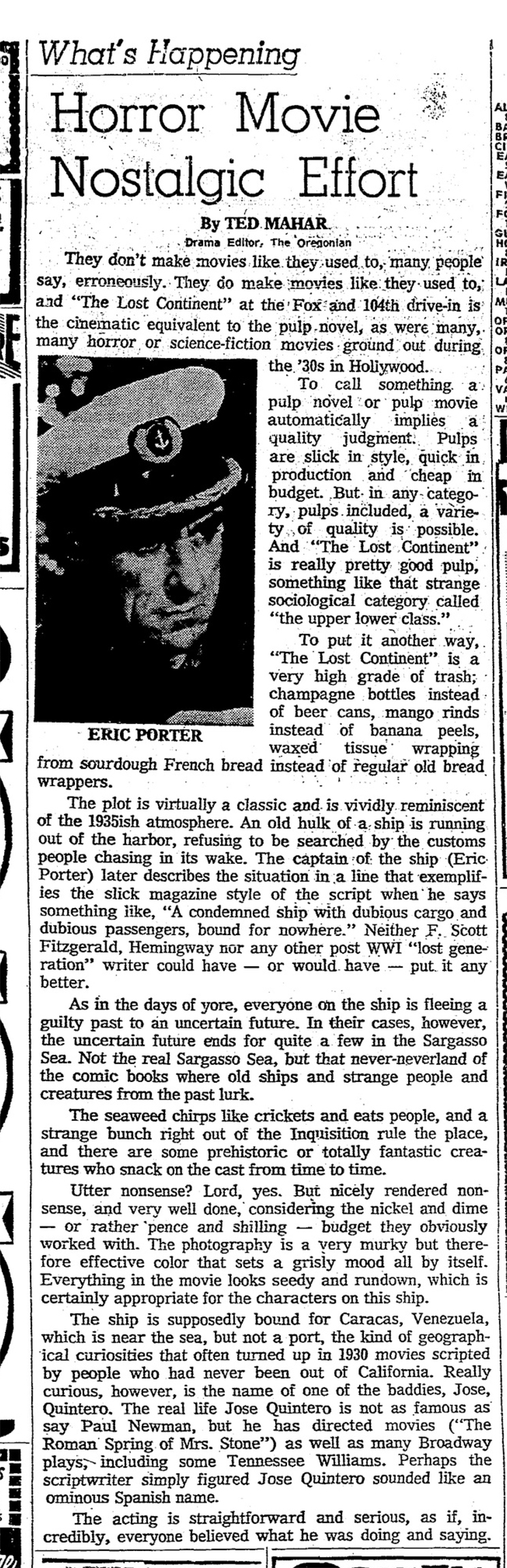
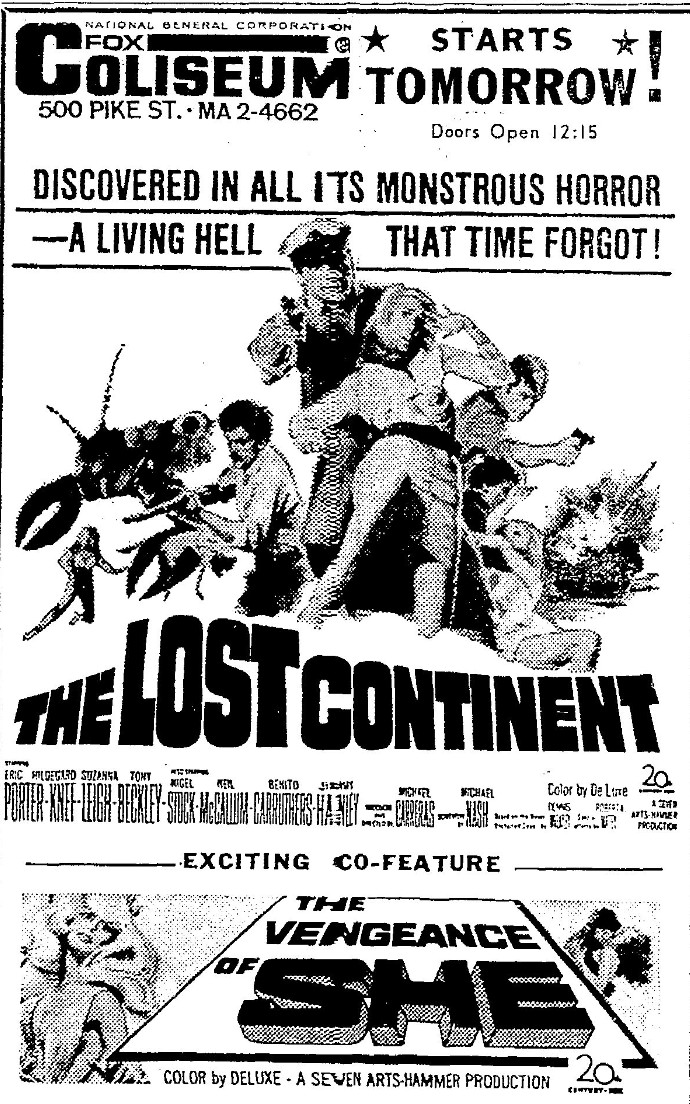
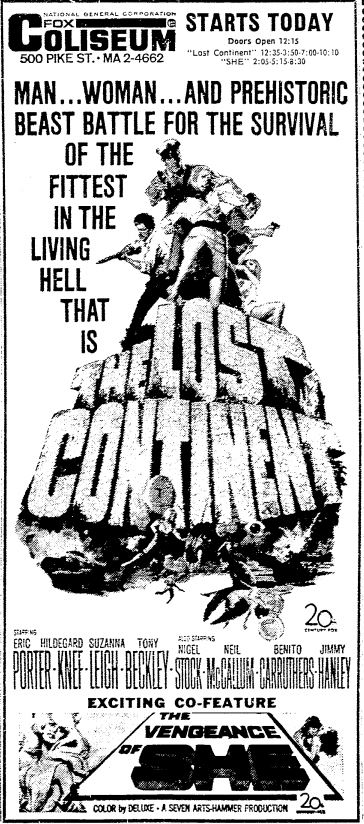
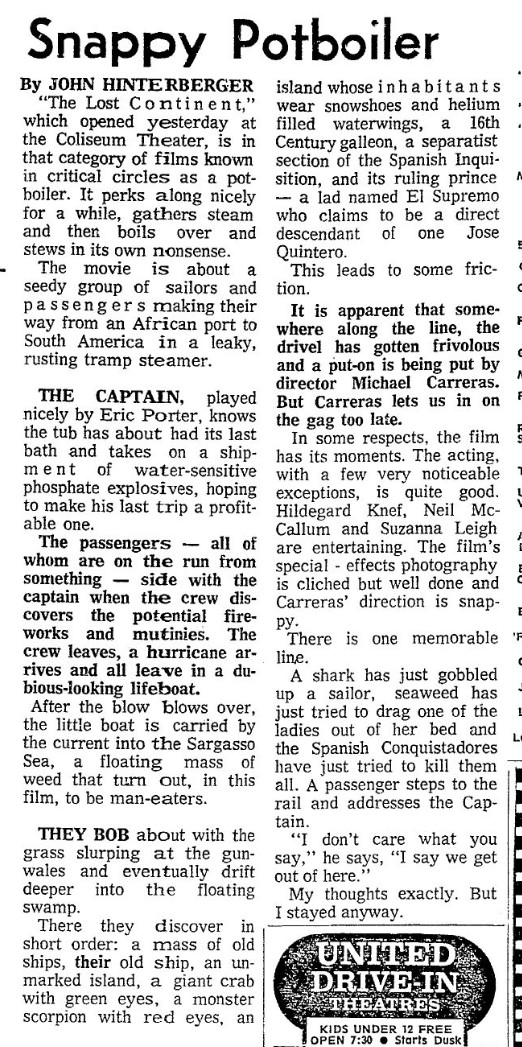
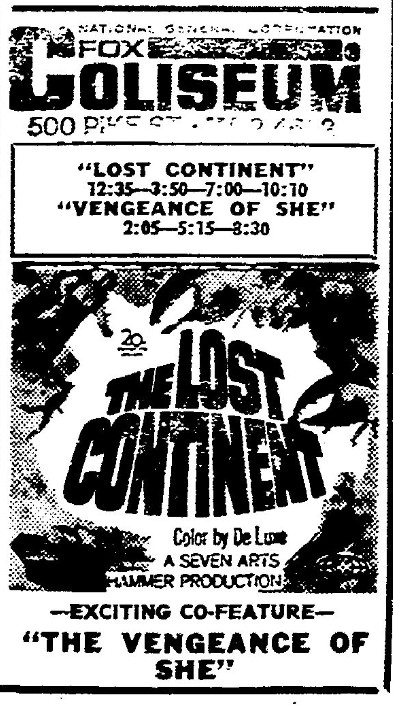
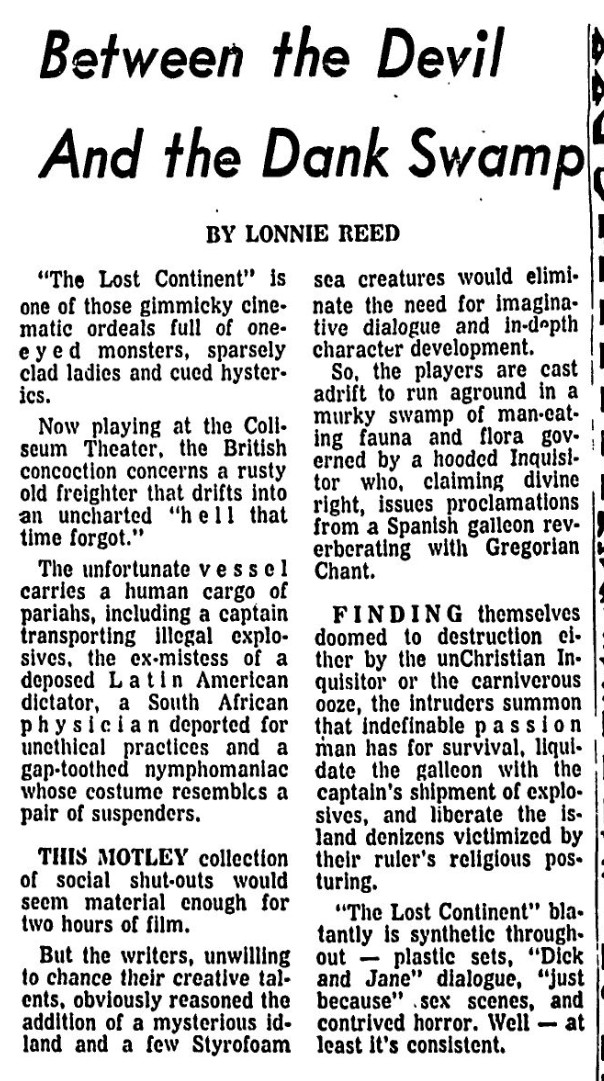
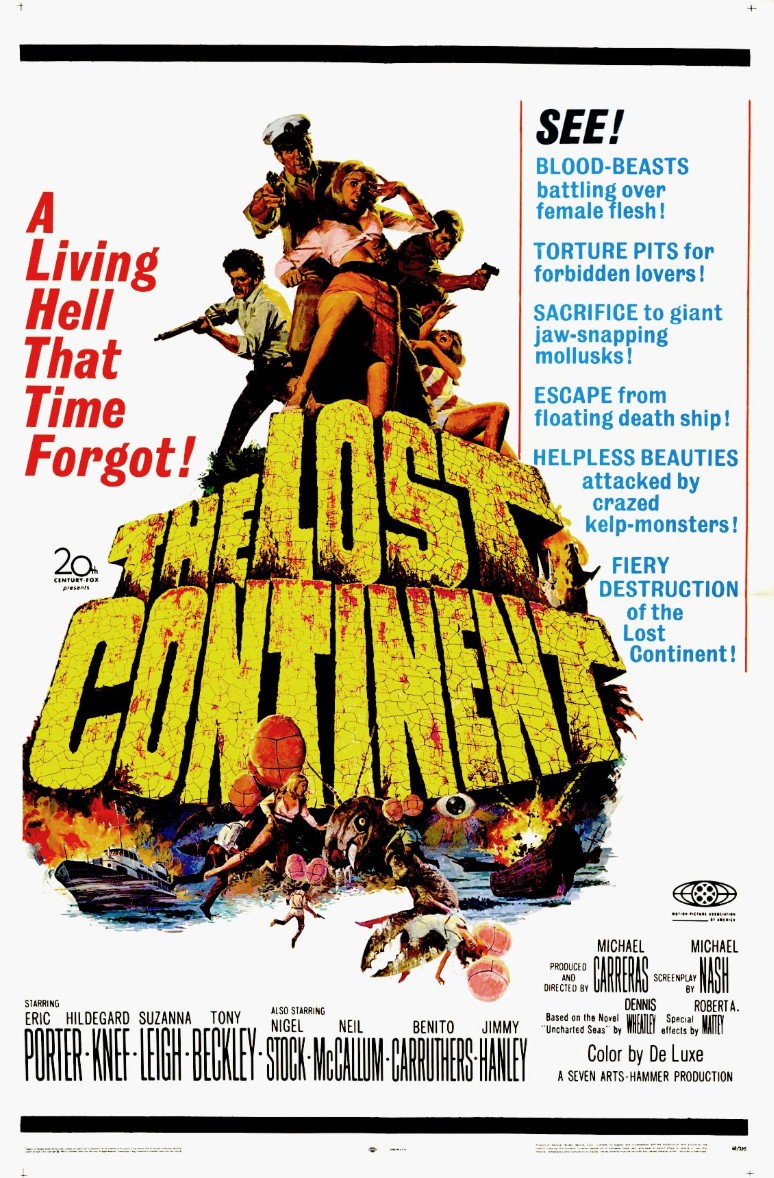
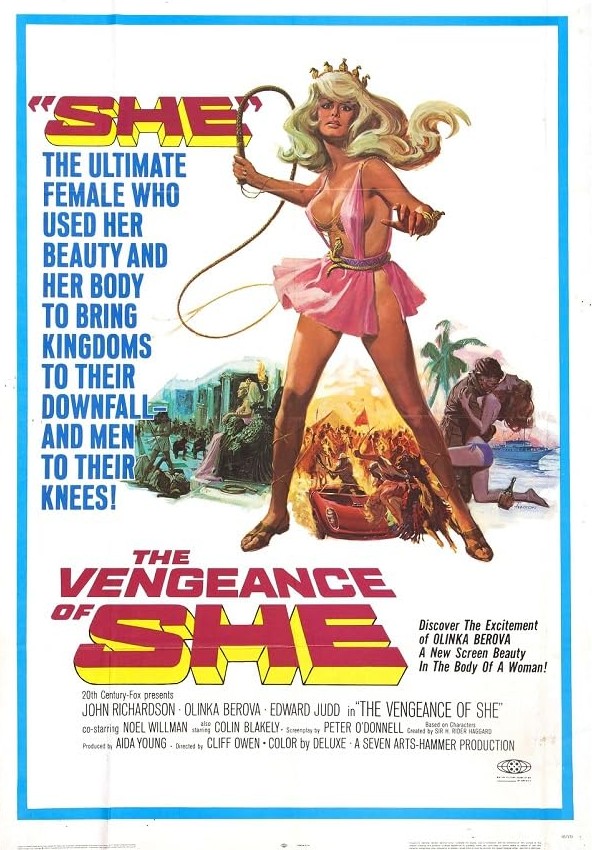
This is a collection of media from the initial runs of "The Lost Continent"/"The Vengeance of She" (1968) in the Pacific Northwest.
Click on images for larger versions.
The Lost Continent (1968)
"The Lost Continent" (1968) is a feverish plunge into the surreal and the grotesque, a film that defies easy categorization and revels in its own chaotic imagination. Directed by Michael Carreras and produced by Hammer Films, it begins as a maritime thriller but quickly mutates into a hallucinatory voyage through a forgotten world. The narrative follows a motley group of morally compromised passengers aboard a decrepit steamer, each fleeing their own pasts, secrets, and sins. Their journey, ostensibly a routine crossing, becomes a descent into a realm where nature and history have conspired to trap the damned.
What sets "The Lost Continent" apart is its audacious blend of genres. It borrows the structure of a disaster film, the mood of Gothic horror, and the pulp sensibilities of adventure serials, all while layering in allegorical overtones. The film’s visual style is lurid and theatrical, with fog-drenched sets, monstrous flora, and bizarre costuming that evoke a dreamlike unreality. The Sargasso Sea, where the characters become stranded, is not merely a geographical location but a symbolic limbo—a place where time has collapsed and civilizations have ossified into ritualistic madness.
Carreras crafts a world that is both claustrophobic and expansive, where the threat is not just physical but existential. The characters, stripped of their societal roles, are forced into a brutal confrontation with their own natures. The film’s pacing is erratic, veering from melodrama to spectacle, but this unevenness contributes to its unsettling tone. There is a sense that anything might happen—and often does—with little regard for conventional logic or narrative restraint.
Despite its camp elements and occasional lapses in coherence, "The Lost Continent" possesses a strange power. It is a film that embraces its excesses and uses them to explore themes of guilt, survival, and the collapse of order. Beneath its pulp exterior lies a meditation on the fragility of civilization and the monstrous forms it can take when untethered from reason. For viewers attuned to its eccentric rhythms and symbolic density, "The Lost Continent" offers a singular experience—one that lingers like a half-remembered nightmare.
Directors: Michael Carreras, Leslie Norman
Writers: Michael Carreras, Dennis Wheatley
Stars: Eric Porter, Hildegard Knef, Suzanna Leigh
Buy "The Lost Continent" (1967) bluray on Amazon (SPONSORED)
Buy "The Lost Continent" (1967) DVD on Amazon (SPONSORED)
The Vengeance of She (1968)
"The Vengeance of She" (1968) is a curious and often hypnotic entry in Hammer Films’ catalogue, serving as a loose sequel to their earlier success "She" but diverging in tone and narrative ambition. Directed by Cliff Owen, the film trades the exotic mysticism of its predecessor for a more psychological and dreamlike journey, one that unfolds across sun-drenched European landscapes and culminates in the mythical city of Kuma. At its core, the story follows Carol, a young woman plagued by visions and drawn by an unseen force toward a destiny she neither understands nor controls. Her odyssey is marked by encounters with strangers who seem to know more about her fate than she does, and by a growing sense of dislocation from reality.
What distinguishes "The Vengeance of She" is its atmosphere of eerie inevitability. The film leans into themes of reincarnation, identity, and the seductive pull of immortality, all wrapped in a gauzy, almost trance-like aesthetic. Olinka Berova’s performance as Carol is enigmatic—her presence is more symbolic than emotive, which suits the film’s tone of mythic abstraction. The narrative unfolds with a deliberate pace, emphasizing mood over action, and often blurring the line between psychological disturbance and supernatural influence.
Visually, the film is a blend of Mediterranean beauty and stylized ritualism. The lost city of Kuma, though less lavishly realized than in "She," retains a sense of ancient grandeur and spiritual decay. The production design, while constrained by budget, evokes a timeless realm where power and desire have calcified into ceremony. Mario Nascimbene’s score adds a haunting layer to the proceedings, reinforcing the sense that Carol’s journey is as much inward as outward.
Despite its flaws—chiefly a fragmented plot and underdeveloped supporting characters—"The Vengeance of She" offers a compelling meditation on the allure and danger of surrendering to a preordained identity. It’s a film that operates more as a mood piece than a conventional fantasy, inviting viewers to drift through its strange rhythms and contemplate the cost of eternal life. For those attuned to its quiet intensity and mythic undercurrents, it reveals a melancholic beauty beneath its pulp exterior.
Director: Cliff Owen
Writers: Peter O'Donnell, H. Rider Haggard
Stars: John Richardson, Olga Schoberová, Edward Judd
Buy "The Vengeance of She" (1967) bluray on Amazon (SPONSORED)
Buy "The Vengeance of She" (1967) DVD on Amazon (SPONSORED)
Buy "The Lost Continent" (1967) bluray on Amazon (SPONSORED)
Buy "The Lost Continent" (1967) DVD on Amazon (SPONSORED)
Buy "The Vengeance of She" (1967) bluray on Amazon (SPONSORED)
Buy "The Vengeance of She" (1967) DVD on Amazon (SPONSORED)
