This is a collection of media from the initial runs of "A Taste of Blood" (1967)/"Teenage Strangler" (1964) in the Pacific Northwest. I could find no evidence that either film played Portland.
Click on images for larger versions.
A Taste of Blood (1967)
Often regarded as Herschell Gordon Lewis’s most ambitious work, "A Taste of Blood" stands apart from his more notorious splatter films by embracing a slower, more atmospheric approach to horror. Released in 1967, the film is steeped in Gothic sensibilities, yet it transplants the vampire mythos into a distinctly American setting before spiraling into a transatlantic revenge narrative. Lewis, known for his exploitation roots, here attempts a more classical structure, drawing on the legacy of Dracula while infusing the tale with a uniquely mid-century paranoia and moral ambiguity.
The film’s tone is meditative, almost somber, with a protagonist whose transformation is as psychological as it is supernatural. The narrative unfolds with deliberate pacing, allowing the audience to witness the erosion of identity and the emergence of a cold, calculating force driven by ancestral vengeance. Lewis’s direction favors long takes and theatrical dialogue, which, while occasionally stilted, contributes to the film’s eerie, dreamlike quality. The cinematography, though modest, uses shadow and framing to evoke a sense of dread that lingers beneath the surface, eschewing overt gore in favor of suggestion and mood.
"A Taste of Blood" also reflects the cultural anxieties of its era—particularly the tension between modernity and inherited legacy. The protagonist’s descent into vampirism can be read as a metaphor for the inescapable pull of history, a theme that resonates with Cold War-era fears of ideological contamination and the loss of personal agency. The film’s American settings, juxtaposed with its European lineage, underscore a transgenerational conflict that mirrors the societal upheavals of the 1960s.
While not without its flaws—some performances are uneven, and the runtime stretches the limits of its narrative—"A Taste of Blood" remains a fascinating artifact of genre cinema. It’s a film that rewards patience, offering a slow-burn descent into horror that is more psychological than visceral. For viewers attuned to subtext and atmosphere, it reveals Lewis as a filmmaker capable of more than shock value, crafting a tale that is as much about identity and legacy as it is about vampiric lore.
Director: Herschell Gordon Lewis
Writer: Donald Stanford
Stars: Bill Rogers, Elizabeth Lee, William Kerwin
Buy "A Taste of Blood" (1967) DVD on Amazon (SPONSORED)
Teenage Strangler (1964)
"Teenage Strangler" is a curious artifact of mid-1960s independent cinema, a low-budget crime thriller that blends juvenile delinquency tropes with a proto-psychological horror framework. Directed by Ben Parker and filmed in Huntington, West Virginia, the film operates within the aesthetic and thematic confines of its era, yet manages to evoke a surprisingly dark undercurrent beneath its modest production values. At first glance, it appears to be a straightforward whodunit centered around a series of murders targeting young women, but its true intrigue lies in how it portrays the social fabric of a small town unraveling under the weight of suspicion and fear.
The narrative unfolds through a combination of procedural investigation and character-driven tension, with the local police attempting to track down a killer whose identity is concealed behind layers of misdirection and community dysfunction. What sets "Teenage Strangler" apart from other exploitation fare of the time is its unsettling portrayal of adolescence—not as a time of innocent rebellion, but as a volatile period marked by alienation, repression, and emotional instability. The film’s central figure, a quiet and seemingly well-mannered teenager, becomes the focal point of this psychological unease, his presence gradually shifting from benign to ominous through subtle visual cues and behavioral tics.
Stylistically, the film is raw and unpolished, yet this roughness contributes to its eerie authenticity. The performances, often amateurish, lend a kind of accidental realism to the proceedings, as if the viewer is peering into a community unprepared for the darkness lurking within its own youth. The cinematography is functional but occasionally striking, using stark lighting and claustrophobic framing to heighten the sense of paranoia. A musical interlude—unexpected and tonally jarring—adds to the film’s off-kilter charm, reinforcing its status as a cult oddity.
Culturally, "Teenage Strangler" taps into the anxieties of postwar America, where the rise of youth culture was met with both fascination and dread. The film’s depiction of drag-racing gangs, absentee parents, and moral panic reflects a society grappling with the perceived breakdown of traditional values. It doesn’t offer easy answers or moral clarity; instead, it presents a community in denial, more concerned with appearances than accountability.
Though it may lack the polish or narrative sophistication of more celebrated genre entries, "Teenage Strangler" endures as a compelling snapshot of its time—a film that, beneath its surface, explores the fragility of innocence and the ease with which violence can emerge from the most ordinary of places. Its cult status, amplified by later rediscovery and affectionate ridicule, only underscores its strange power: a film that is both awkward and haunting, naïve and unnervingly prescient.
Director: Ben Parker
Writer: Clark Davis
Stars: Bill Bloom, John Ensign, Rick Harris
Buy "Teenage Strangler" (1964) DVD on Amazon (SPONSORED)
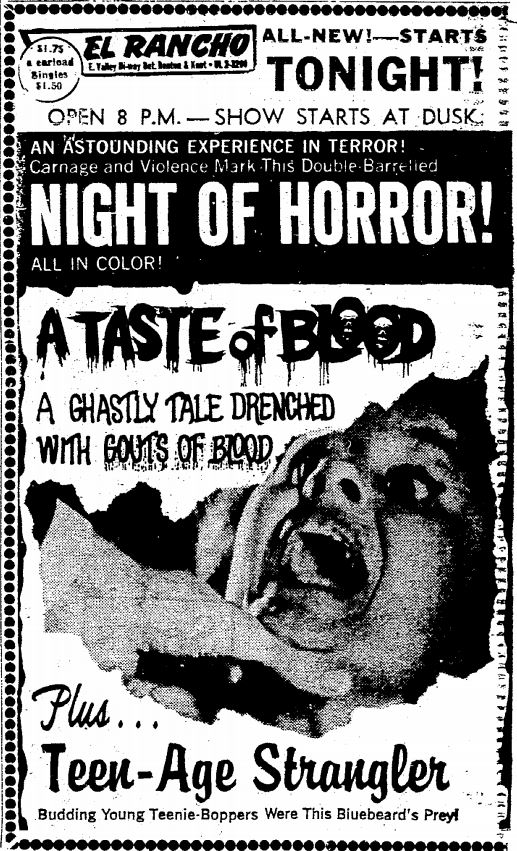
August 7, 1968 ad (Seattle)
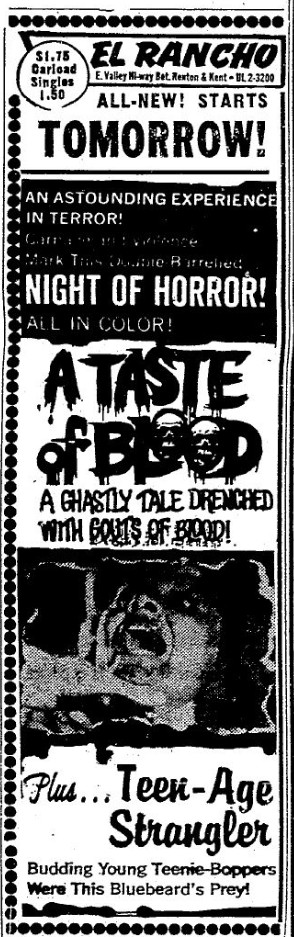
August 6, 1968 ad (Seattle)
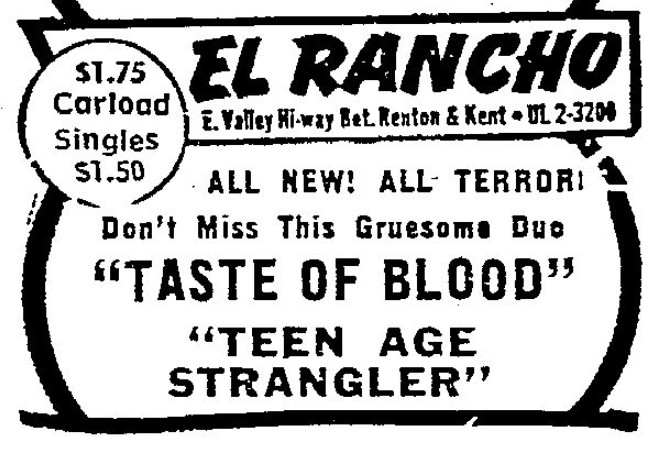
August 9, 1968 ad (Seattle)
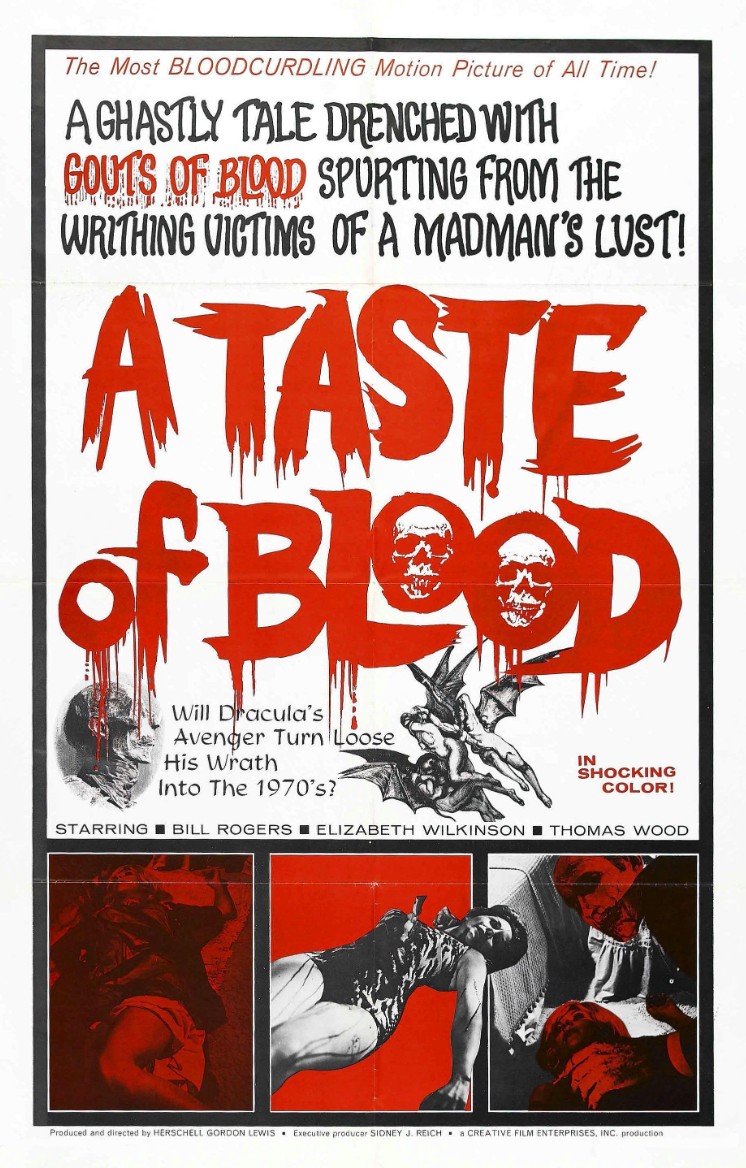
A Taste of Blood (1967) poster
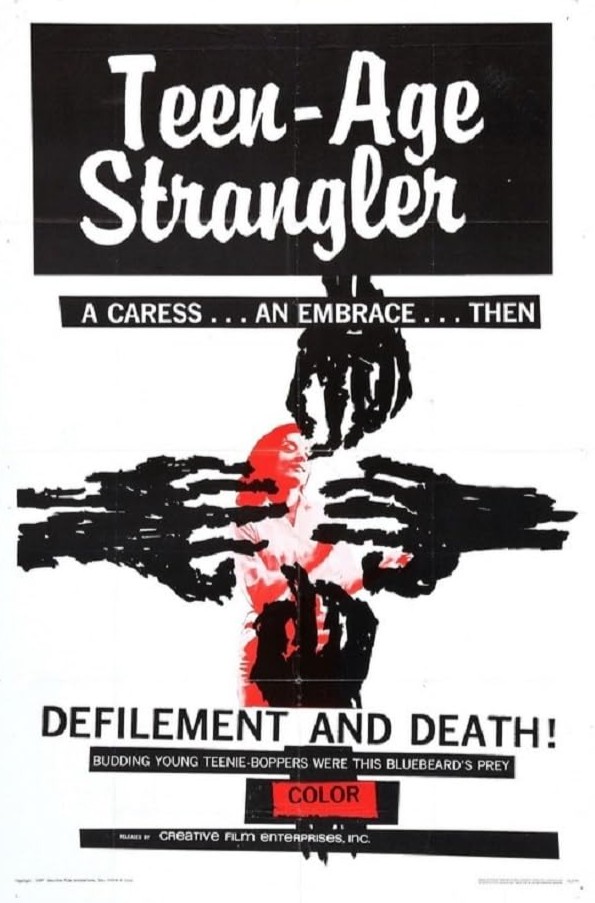
Teenage Strangler (1964) poster
A Taste of Blood (1967) trailer
Buy "A Taste of Blood" (1967) DVD on Amazon (SPONSORED
Teenage Strangler (1964) trailer
Buy "Teenage Strangler" (1964) DVD on Amazon (SPONSORED)
