This is a collection of media from the initial runs of "Sweden: Heaven and Hell" (1968) in the Pacific Northwest.
Click on images for larger versions.
Sweden: Heaven and Hell (1968)
“Sweden: Heaven and Hell” is one of those late‑1960s cultural artifacts that feels less like a documentary and more like a feverish snapshot of a moment when Europe was renegotiating its identity. Presented as an exposé of Swedish society, the film uses the structure of reportage to deliver something far more stylized and sensational. It positions itself as a guided tour through a supposedly permissive, liberated nation, yet what emerges is a portrait shaped as much by the anxieties of its makers as by the realities it claims to observe.
The film’s rhythm is built on contrasts: idyllic landscapes set against urban restlessness, images of social progress juxtaposed with scenes meant to shock or titillate. This tension gives the film its peculiar energy. Rather than offering a cohesive sociological argument, it assembles fragments—nightlife, youth culture, sexuality, immigration, religion—into a mosaic that reflects the era’s fascination with the idea of Sweden as a social experiment. The narration, delivered with a tone of investigative authority, becomes part of the film’s performance, guiding viewers through a series of vignettes that often reveal more about the filmmakers’ preconceptions than about the subjects themselves.
Visually, the film leans into the aesthetics of European exploitation cinema: bold colors, stylized compositions, and a willingness to linger on scenes designed to provoke. Yet beneath the surface-level sensationalism, there’s an undercurrent of cultural curiosity. The film captures a society grappling with modernity, shifting moral codes, and the pressures of global attention. Even when its conclusions feel exaggerated or moralizing, the imagery conveys a genuine fascination with the contradictions of a country often idealized as a model of social democracy.
What makes “Sweden: Heaven and Hell” compelling today is not its accuracy but its role as a cultural artifact. It reflects the international gaze directed at Scandinavia during a period of rapid change, and it reveals how documentary form can be bent toward spectacle without fully abandoning its observational impulses. The result is a film that oscillates between earnest inquiry and lurid display, offering a window into both Sweden’s evolving self-image and the cinematic trends that shaped how the world interpreted it.
Director: Luigi Scattini
Writer: Luigi Scattini
Stars: Edmund Purdom, Enrico Maria Salerno, Jean Topart
Buy "Sweden: Heaven and Hell" (1968) DVD on Amazon (SPONSORED)
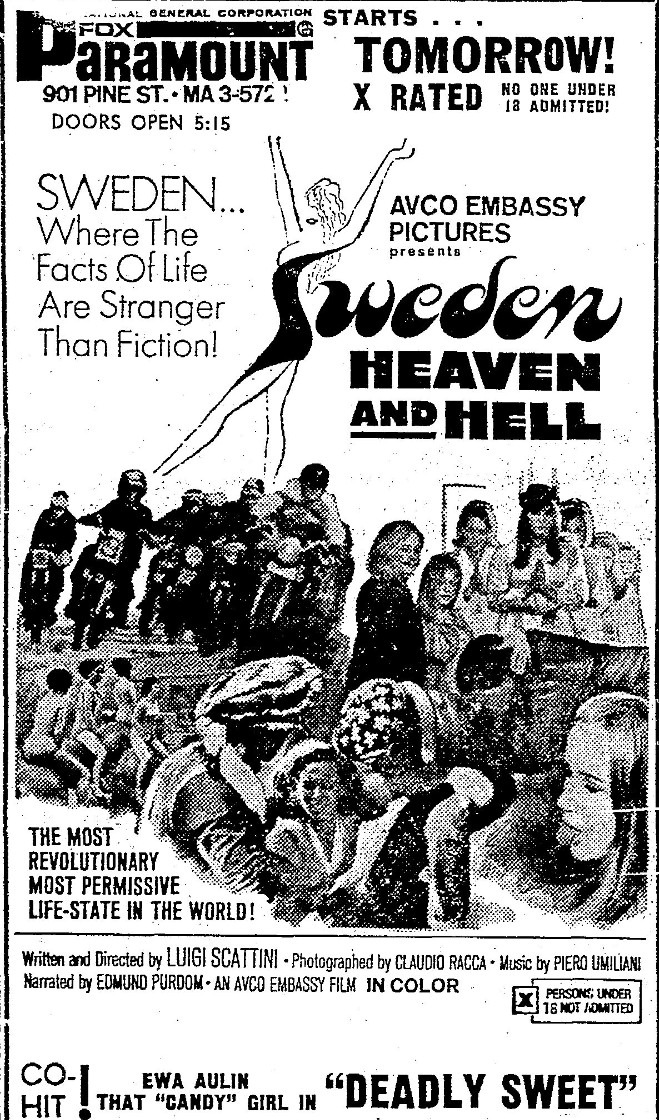
August 19, 1969 ad (Seattle)

August 20, 1969 ad (Seattle)

August 21, 1969 ad (Seattle)

September 17, 1969 ad (Portland)

September 18, 1969 ad (Portland)
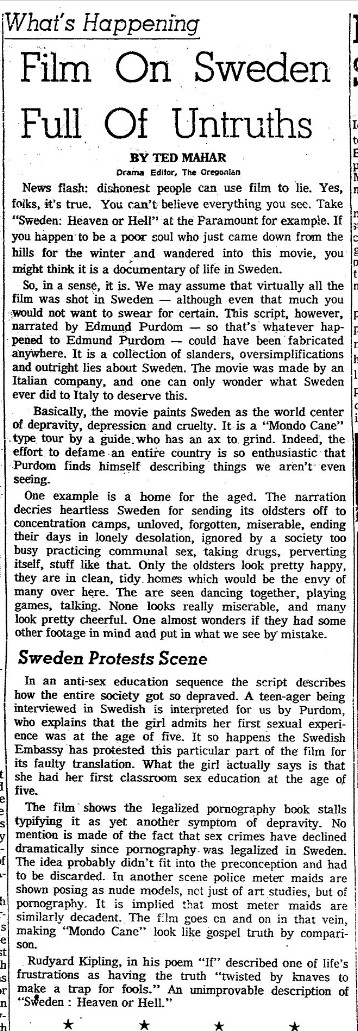
September 19, 1969 article (Portland)
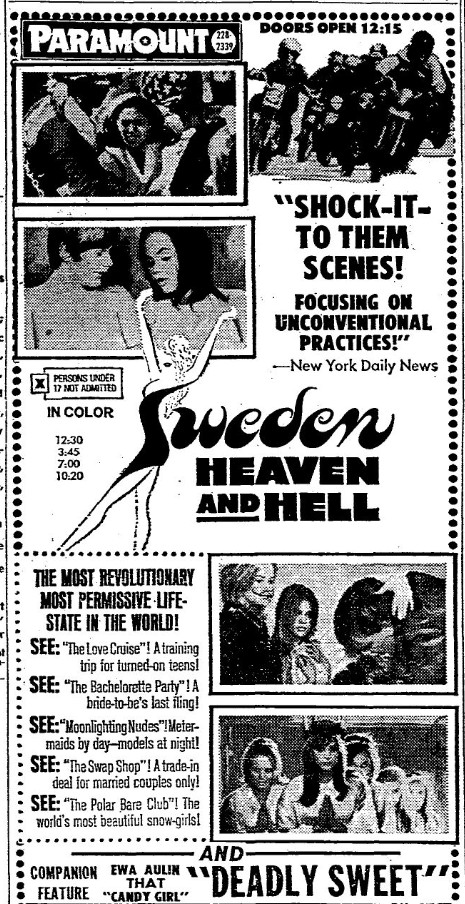
September 19, 1969 ad (Portland)
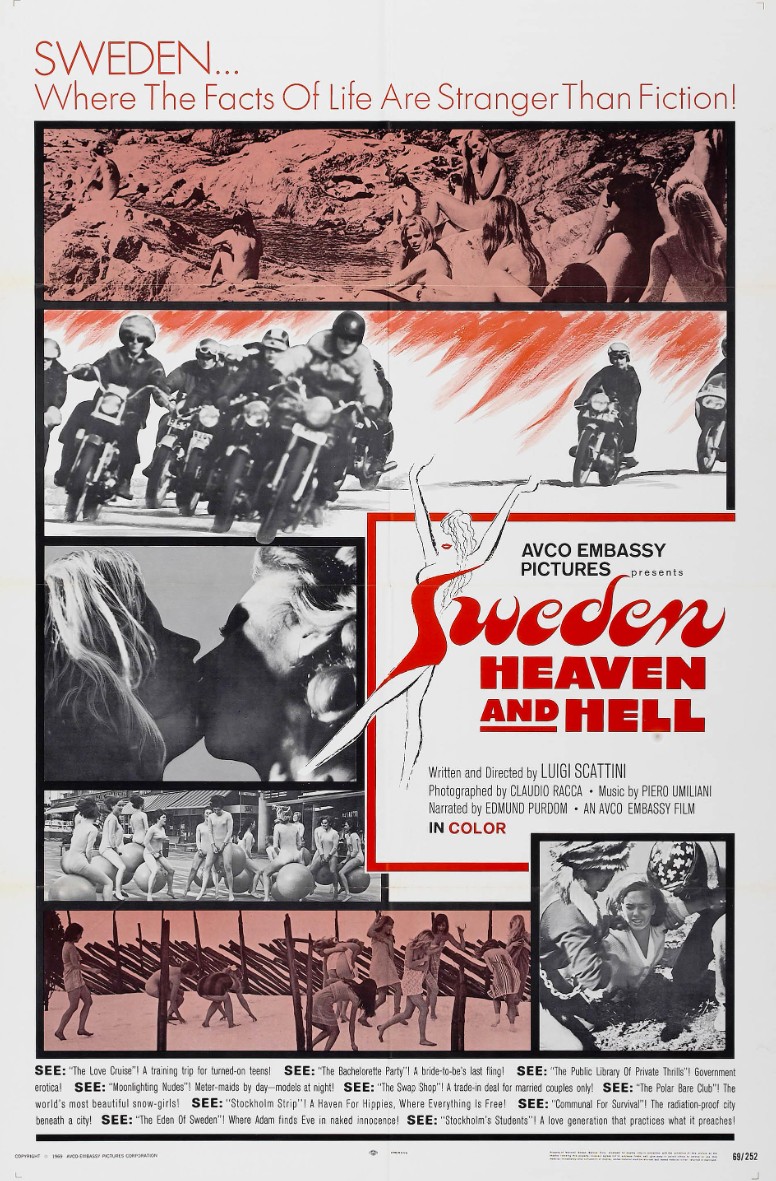
Sweden: Heaven and Hell (1968) poster
