This is a collection of media from the initial runs of "Phillip and Marie" (AKA "The Alley Tramp" 1968) in the Pacific Northwest. It doesn't appear Seattle ever got this H.G. Lewis sexploitationer.
Click on images for larger versions.
Phillip and Marie (AKA "The Alley Tramp" 1968)
"Phillip and Marie," also known as The Alley Tramp (1968), is a low-budget exploitation film that uses its provocative subject matter to explore themes of youthful rebellion, fractured family dynamics, and the moral anxieties of its era.
The film centers on Marie, a restless teenager whose encounters with her cousin Phillip and others become a lens through which the movie examines the breakdown of traditional structures. Rather than presenting a straightforward cautionary tale, "Phillip and Marie" situates its narrative in the blurred space between curiosity and transgression, reflecting the late 1960s’ cultural climate, in which generational conflict and sexual liberation were both celebrated and feared. The story unfolds as a series of escalating encounters, each underscoring Marie’s search for identity and agency in a world where adults themselves are compromised by secrecy and infidelity.
Visually, the film bears the hallmarks of exploitation cinema of the period: modest production values, functional camerawork, and a reliance on intimate interiors rather than expansive settings. Yet this simplicity contributes to its atmosphere, emphasizing confinement and the claustrophobic nature of suburban domestic life. The camera often lingers on Marie in moments of solitude, underscoring her alienation and the tension between her youthful vulnerability and her attempts at self-assertion. The editing style is direct, sometimes abrupt, mirroring the instability of the characters’ lives.
Thematically, "Phillip and Marie" resonates with broader cultural anxieties of the late 1960s. It reflects fears about the erosion of parental authority, the destabilization of the nuclear family, and the perceived dangers of adolescent sexuality. The film’s depiction of adults engaged in their own clandestine affairs highlights hypocrisy, suggesting that Marie’s rebellion is not an isolated aberration but part of a larger cycle of moral compromise. In this way, the film critiques the veneer of respectability in middle-class life, exposing the contradictions beneath it.
Performances are raw and uneven, typical of exploitation cinema, yet they carry a certain authenticity. Marie’s portrayal captures both naivety and defiance, while Phillip’s role embodies the complicity of those who exploit vulnerability. The supporting characters—parents, authority figures, and fleeting lovers—function less as fully developed individuals than as embodiments of societal pressures and failures. This stylization reinforces the film’s allegorical quality, where personal drama becomes a reflection of cultural unease.
In retrospect, "Phillip and Marie" stands as a document of its time: a film that straddles the line between sensationalism and social commentary. While its narrative is deliberately lurid, its underlying concerns—identity, freedom, hypocrisy, and the costs of rebellion—remain relevant. For viewers interested in cult and vintage cinema, it offers a glimpse into how exploitation films mirrored and distorted the anxieties of the late 1960s, using shock and taboo not only to titillate but also to provoke reflection on the fragility of social norms.
In short, "Phillip and Marie" is more than just a scandalous curiosity; it is a cultural artifact that captures the tension between liberation and disintegration in a decade defined by upheaval.
Director: Herschell Gordon Lewis
Writers: Paul Gordone, Jean Michel, Louise Downe
Stars: Julia Ames, Jean Lamee, Lisa Bourdon
Buy "Phillip and Marie" (AKA "The Alley Tramp" 1968) DVD on Amazon (SPONSORED)
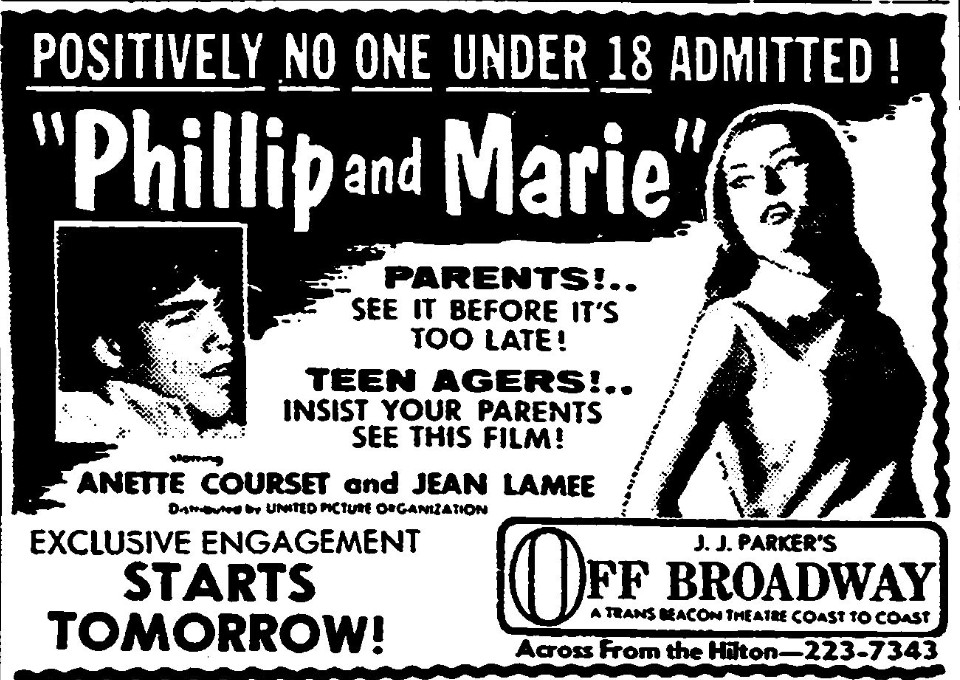
February 25, 1969 ad (Portland)
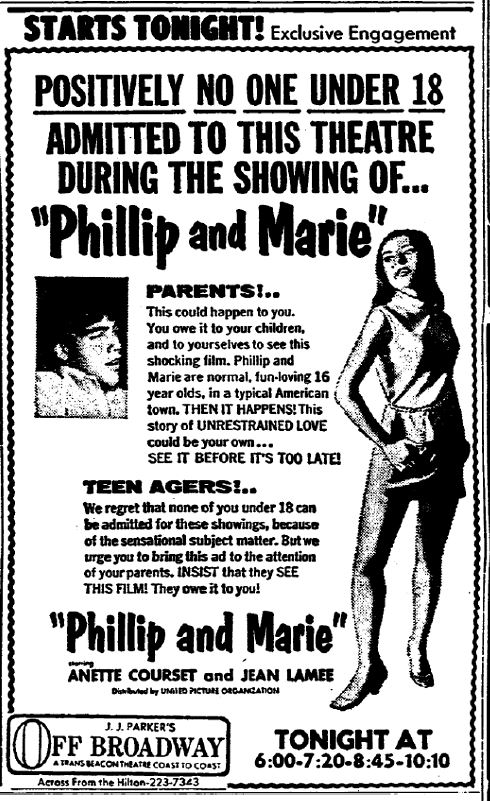
February 26, 1969 ad (Portland)
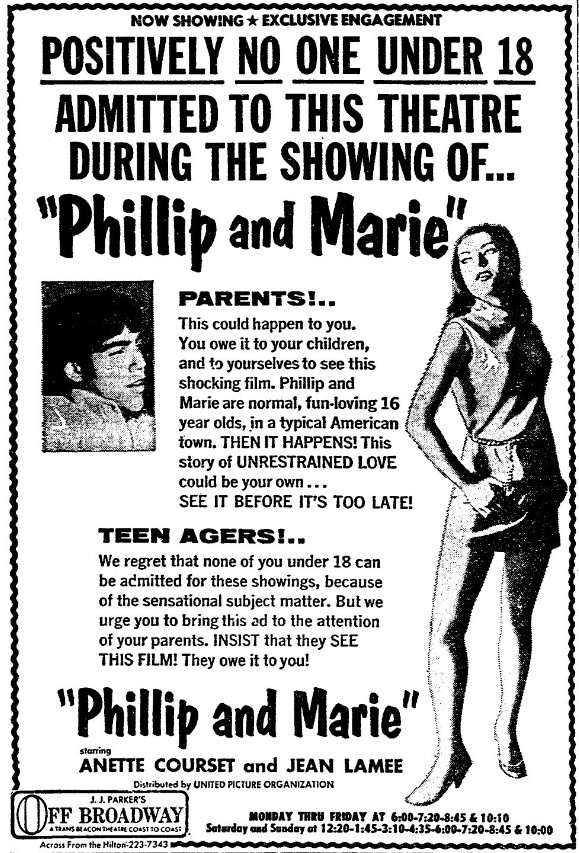
February 28, 1969 ad (Portland)
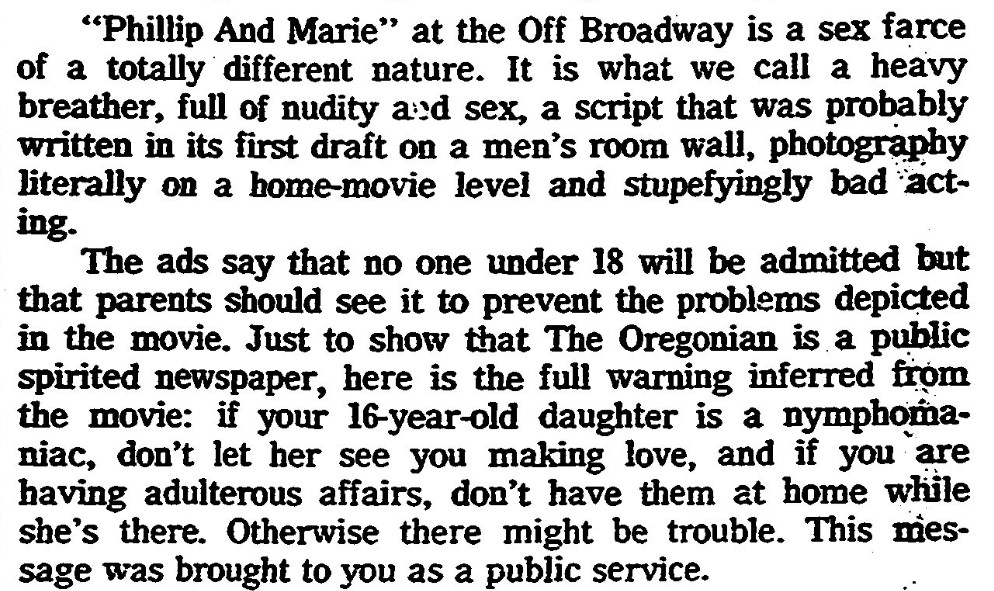
March 1, 1969 review (Portland)
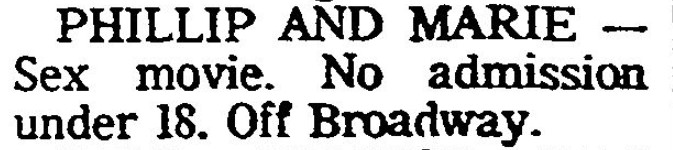
March 9, 1969 ad (Portland)
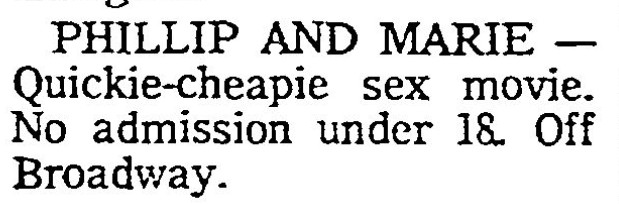
March 16, 1969 ad (Portland)
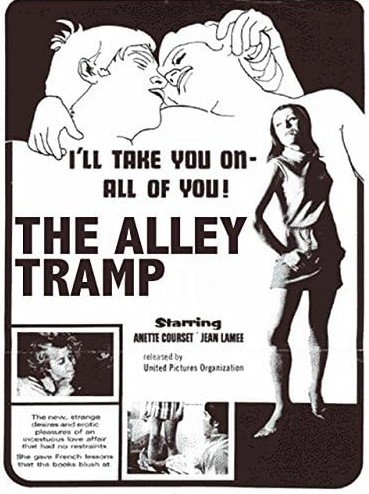
The Alley Tramp (1968) poster
