This is a collection of media from the initial runs of H.G. Lewis' "The Blood Trilogy" (1963/1964/1965) in the Pacific Northwest. It took several years, but the good people of Portland and Seattle were finally able to see these all-time exploitation classics. Perhaps there was a little too much "blood" for the Portland papers to run any proper ads.
Click on images for larger versions.
Blood Feast (1963)
“Blood Feast” (1963) is a landmark in American horror cinema—not for its narrative sophistication or technical polish, but for its audacious plunge into graphic violence and taboo subject matter at a time when mainstream films were still cautiously restrained. Directed by Herschell Gordon Lewis, often dubbed the “Godfather of Gore,” the film is widely recognized as the first splatter movie, a subgenre that prioritizes visceral shock over psychological tension or traditional suspense.
Set in a sun-drenched Florida suburb, “Blood Feast” juxtaposes the banality of everyday life with the grotesque rituals of its antagonist, creating a jarring tonal dissonance that amplifies its horror. The plot, while rudimentary, serves as a scaffold for a series of increasingly lurid set pieces. Lewis eschews subtlety in favor of blunt-force storytelling, using garish lighting and primitive special effects to evoke a sense of the uncanny. The film’s low-budget aesthetic—marked by stiff performances, abrupt editing, and minimal sound design—paradoxically enhances its raw, transgressive energy. It feels less like a polished production and more like a forbidden artifact, something stumbled upon rather than deliberately sought out.
What makes “Blood Feast” culturally significant is not its execution but its intent. It represents a rupture in cinematic decorum, a deliberate provocation aimed at audiences accustomed to suggestion rather than depiction. In doing so, it laid the groundwork for a new kind of horror—one that would evolve through grindhouse theaters and midnight screenings into a full-fledged genre movement. The film’s gleeful disregard for narrative coherence and moral restraint reflects a broader shift in American culture during the early 1960s, as traditional norms began to fray and underground art forms gained traction.
Though “Blood Feast” may appear crude by contemporary standards, its influence is undeniable. It challenged censorship boundaries, redefined audience expectations, and opened the door for filmmakers to explore horror as a space for excess, spectacle, and subversion. Watching it today is less about being frightened and more about witnessing the birth of a cinematic language that would come to dominate exploitation and cult horror for decades.
Director: Herschell Gordon Lewis
Writers: Louise Downe, David F. Friedman, Herschell Gordon Lewis
Stars: William Kerwin, Mal Arnold, Connie Mason
Two Thousand Maniacs! (1964)
“Two Thousand Maniacs!” (1964) is a feverish blend of Southern Gothic horror and Grand Guignol spectacle, directed by Herschell Gordon Lewis in what would become one of his most notorious and thematically provocative works. While “Blood Feast” introduced audiences to Lewis’s penchant for gore, “Two Thousand Maniacs!” refines that approach into something more narratively coherent and culturally charged, transforming its violence into a grotesque form of historical revenge fantasy.
Set in a fictional Southern town that mysteriously reappears to commemorate its Civil War-era destruction, the film operates as a twisted pageant of regional pride and retribution. The town’s residents, dressed in antebellum garb and brimming with exaggerated hospitality, exude a theatrical charm that quickly curdles into menace. Lewis uses this setting to explore the lingering specter of historical trauma, turning the town into a living monument to unresolved grievances. The film’s tone oscillates between camp and cruelty, with its cheerful folk songs and festive atmosphere serving as a macabre counterpoint to the horrors that unfold.
Visually, “Two Thousand Maniacs!” is more ambitious than its predecessor, employing vivid Technicolor to heighten the surrealism of its violence. The garish palette and exaggerated performances lend the film a dreamlike quality, as if the viewer has stumbled into a warped historical reenactment staged by ghosts with a vendetta. The narrative structure, while simple, is effective in building a sense of dread through repetition and ritual, reinforcing the idea that the town’s actions are part of a cyclical, almost mythic pattern.
What sets “Two Thousand Maniacs!” apart is its willingness to confront the darker undercurrents of American identity. Beneath its surface-level shocks lies a commentary on the persistence of sectional resentment and the romanticization of a violent past. Lewis doesn’t offer resolution or moral clarity; instead, he presents a tableau of vengeance that is both absurd and unsettling, daring the viewer to question the line between commemoration and fanaticism.
Though rough around the edges, “Two Thousand Maniacs!” remains a compelling artifact of exploitation cinema—one that captures a uniquely American unease through its lurid visuals and folkloric horror. It’s a film that doesn’t just revel in gore, but uses it as a language to express something more haunting: the way history can fester when left unexamined.
Director: Herschell Gordon Lewis
Writer: Herschell Gordon Lewis
Stars: Connie Mason, William Kerwin, Jeffrey Allen
Color Me Blood Red (1965)
“Color Me Blood Red” (1965) marks the final installment in Herschell Gordon Lewis’s unofficial “Blood Trilogy,” and while it retains the director’s signature flair for gore and sensationalism, it also introduces a more pointed satire of the art world and its pretensions. The film centers on a deranged painter whose obsession with achieving the perfect shade of red leads him down a path of grotesque innovation, turning his creative process into a literal bloodbath. Unlike its predecessors, “Color Me Blood Red” flirts more openly with dark comedy, using its absurd premise to critique the commodification of art and the cult of artistic genius.
Stylistically, the film continues Lewis’s use of vivid Technicolor, which here becomes a thematic device as well as a visual one. The saturated reds are not merely shocking—they’re symbolic of the protagonist’s descent into madness and the increasingly blurred line between aesthetic beauty and moral depravity. The film’s mise-en-scène is deliberately garish, with beachside locations and pop-art interiors clashing against the visceral horror at its core. This contrast heightens the surreal tone, making the violence feel both theatrical and disturbingly intimate.
“Color Me Blood Red” also reflects a growing self-awareness in Lewis’s work. The characters, particularly those within the art scene, are exaggerated to the point of caricature, suggesting a satirical lens through which the film views its own narrative. The artist’s desperation for recognition and his contempt for critics mirror the exploitation filmmaker’s own outsider status in the cinematic landscape of the 1960s. In this way, the film becomes a kind of meta-commentary—not just on art, but on the act of creating transgressive media in a culture that often dismisses it.
Though rough in execution, “Color Me Blood Red” stands as a fascinating artifact of mid-century horror, one that blends gore with a sly critique of artistic ambition. It’s a film that revels in excess while quietly questioning the value systems that define taste, beauty, and success. Beneath its lurid surface lies a surprisingly pointed reflection on what it means to create—and destroy—in the name of art.
Director{ Herschell Gordon Lewis
Writer: Herschell Gordon Lewis
Stars: Gordon Oas-Heim, Candi Conder, Elyn Warner
Buy "The Blood Trilogy" (1963/1964/1965) Bluray on Ebay
Buy "The Blood Trilogy" (1963/1964/1965) DVD on Ebay
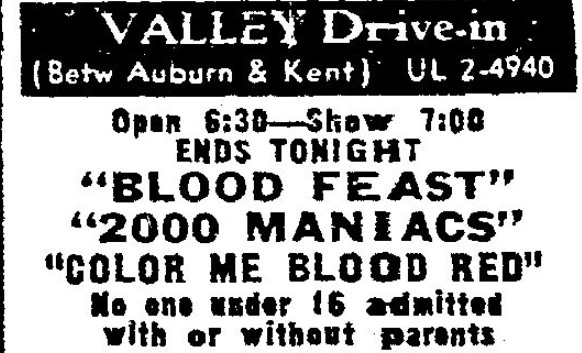
April 16, 1968 ad (Seattle)
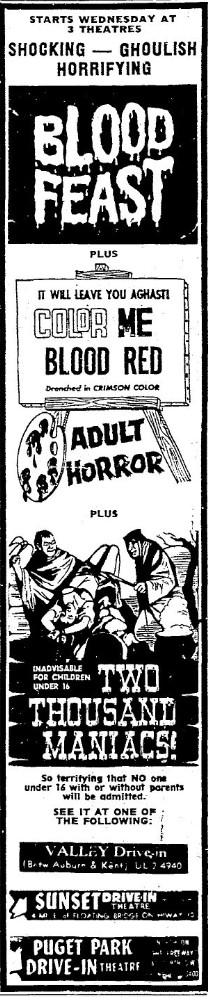
April 9, 1968 ad (Seattle)

April 10, 1968 ad (Seattle)
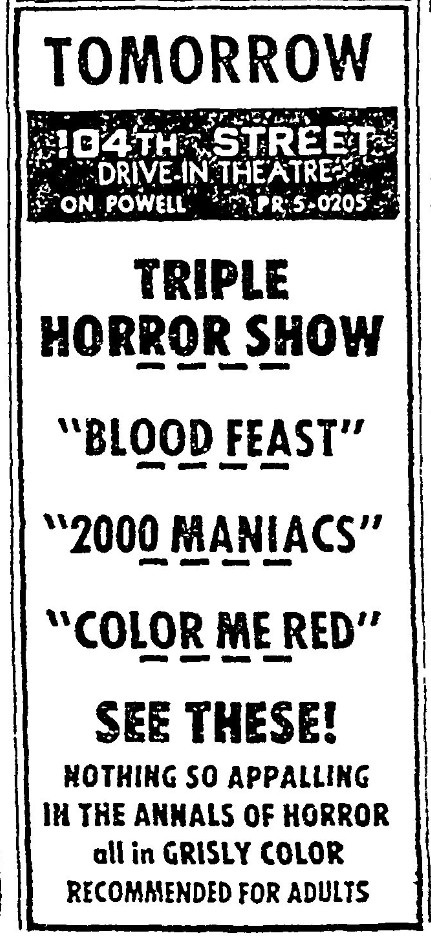
January 7, 1969 ad (Portland)
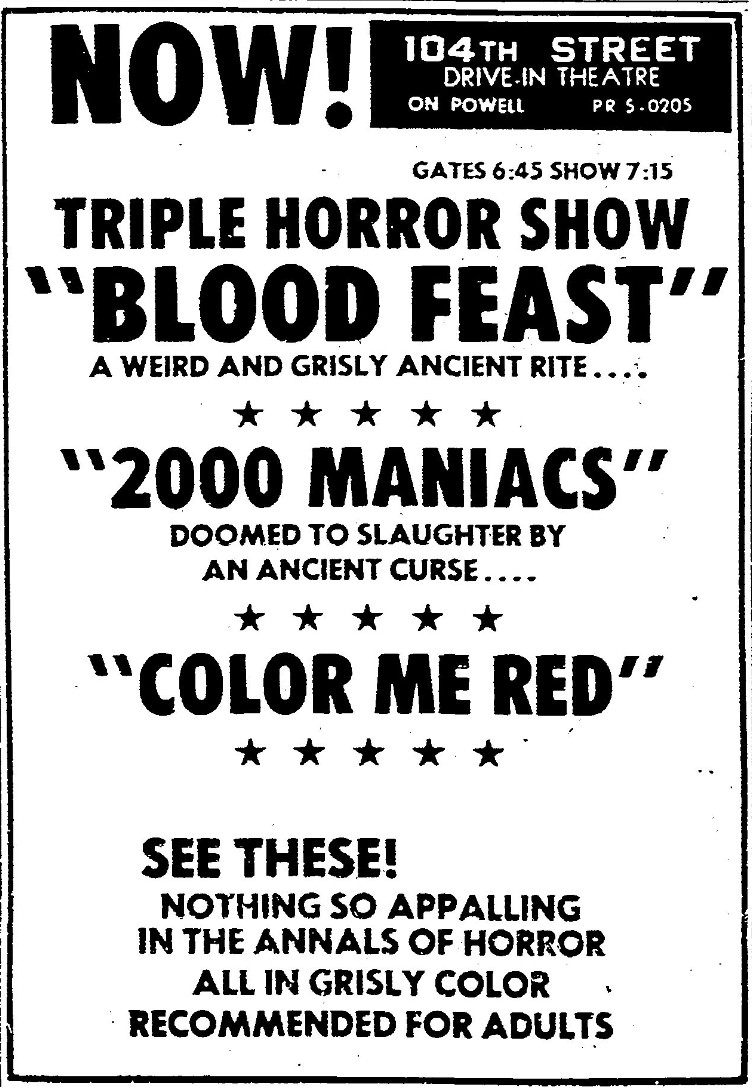
January 8, 1969 ad (Portland)
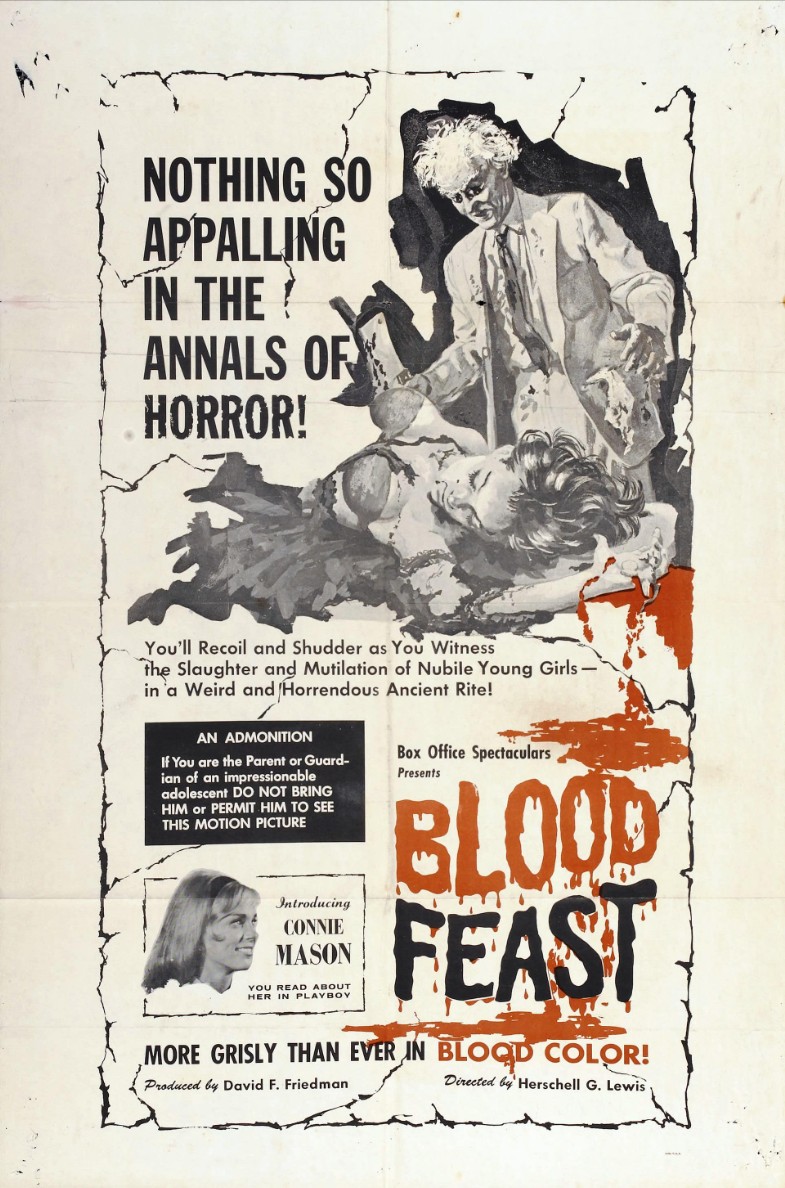
Blood Feast (1963) poster
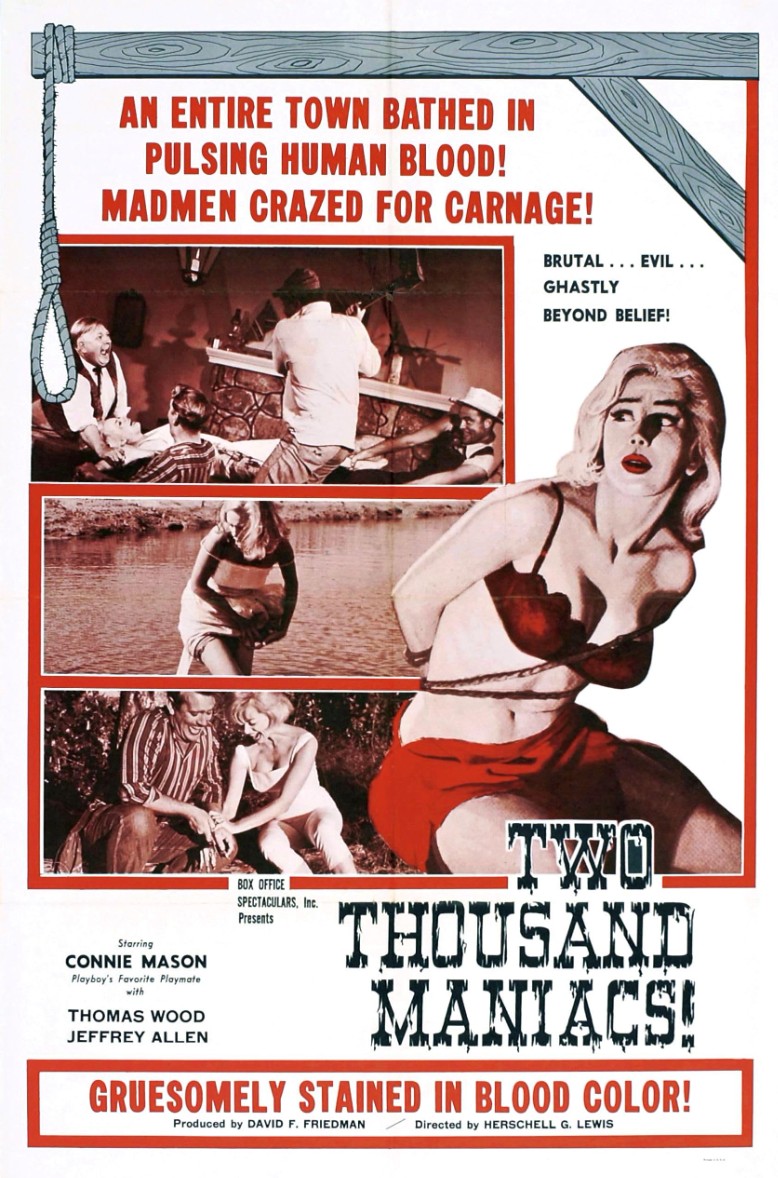
Two Thousand Maniacs! (1964) poster
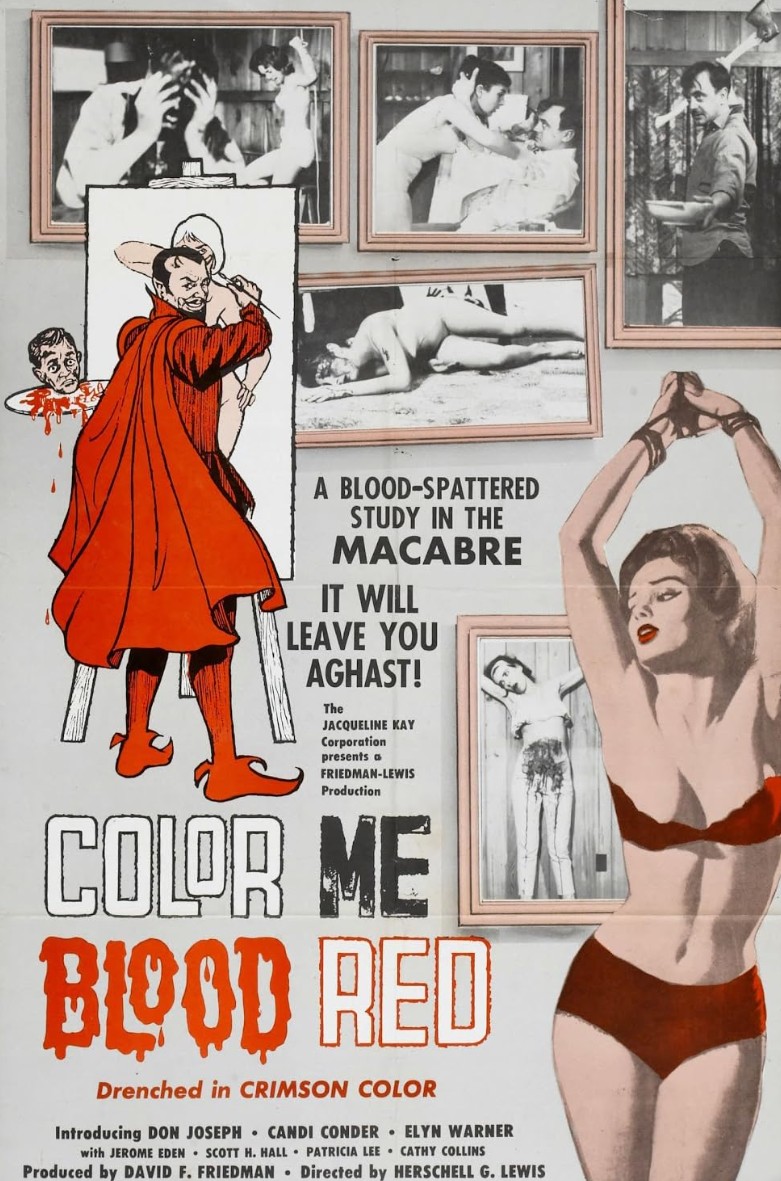
Color Me Blood Red (1965) poster
Blood Feast (1963) trailer
Buy "The Blood Trilogy" (1963/1964/1965) Bluray on Ebay
Buy "The Blood Trilogy" (1963/1964/1965) DVD on Ebay
Two Thousand Maniacs! (1964) trailer
Buy "The Blood Trilogy" (1963/1964/1965) Bluray on Ebay
Buy "The Blood Trilogy" (1963/1964/1965) DVD on Ebay
Color Me Blood Red (1965) trailer
Buy "The Blood Trilogy" (1963/1964/1965) Bluray on Ebay
Buy "The Blood Trilogy" (1963/1964/1965) DVD on Ebay
