Click for larger version
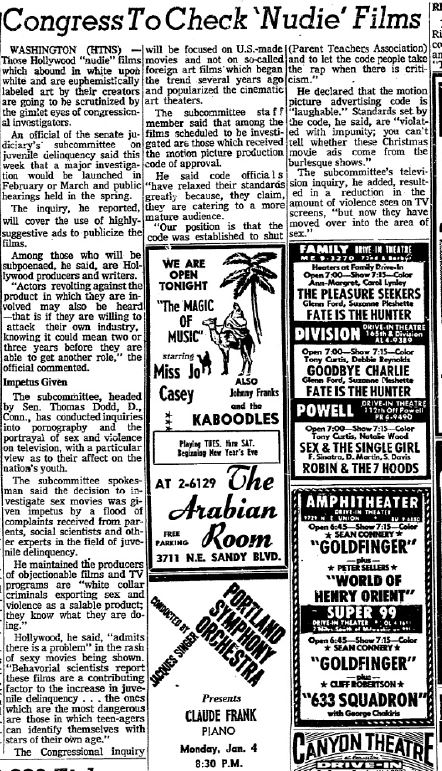
The discourse surrounding the portrayal of nudity in American cinema during 1965 presents a compelling study of cultural and legislative intersections. This article examines the United States Congress’s engagement with the subject of nudity in films during that year, contextualized within the broader narrative of censorship and artistic expression.
Introduction The year 1965 stands as a watershed moment in the history of film censorship in the United States. It was a time when the nation’s moral compass was being recalibrated amidst a burgeoning counterculture movement, and the cinematic representation of nudity became a focal point of legislative concern.
Historical Backdrop The Motion Picture Production Code, commonly known as the Hays Code, has governed the content of American films since the 1930s. By the mid-1960s, however, its influence was diminishing as societal norms evolved. Congress grappled with the challenge of reconciling the First Amendment rights of filmmakers with prevailing public decency standards.
Legislative Scrutiny In 1965, Congress found itself at the nexus of this cultural shift. Hearings and debates reflected the tension between a desire to maintain moral oversight and the need to acknowledge changing social mores. The legislative body was tasked with evaluating the appropriateness of nudity in film, a subject that had hitherto been self-regulated by the industry.
Judicial Influence The judicial landscape was also shifting. The Supreme Court’s decision in Freedman v. Maryland (1965) underscored the constitutional protection of free expression, ruling that films could not be censored without due process. This ruling weakened the authority of local censorship boards and signaled a move towards greater artistic liberty.
The Demise of the Hays Code The Hays Code’s decline was hastened by the increasing inclusion of nudity in films, which reflected a society in the throes of redefining its cultural boundaries. The code’s inability to adapt to the changing climate rendered it obsolete, prompting the film industry to seek alternative means of self-regulation.
Establishment of the MPAA Rating System The Motion Picture Association of America (MPAA) rating system, established in 1968, was a direct response to the challenges faced in 1965. It represented an industry-led initiative to classify films based on content, including nudity, thereby providing guidance to audiences while respecting the creative freedom of filmmakers.
Conclusion The discourse on nudity in films in 1965 encapsulates a pivotal moment in American cultural history. The U.S. Congress’s involvement in this debate marked a transition from stringent censorship to a more nuanced approach that balanced moral considerations with constitutional freedoms. The legacy of 1965 continues to inform contemporary discussions on film censorship and artistic expression.
This article has endeavored to provide an analysis of the complex interplay between legislative action, judicial decisions, and societal values that shaped the portrayal of nudity in American films during the mid-1960s.
