This is a collection of media from the initial runs of "The Gruesome Twosome" and "Something Weird" (1967) in the Pacific Northwest. Looks like these only played in Seattle.
Click on images for larger versions.
The Gruesome Twosome (1967)
"The Gruesome Twosome" is a quintessential entry in the splatter subgenre pioneered by Herschell Gordon Lewis, whose low-budget provocations helped define exploitation cinema in the 1960s. Released in 1967, the film is a lurid blend of grotesque horror and campy absurdity, anchored by a narrative that oscillates between crude comedy and visceral shock. At its core, "The Gruesome Twosome" is a macabre tale of domestic dysfunction, set against the backdrop of a Florida college town where young women begin to mysteriously vanish.
Lewis’s direction leans heavily into the grotesque, with exaggerated performances and garish visuals that heighten the film’s surreal tone. The character of Mrs. Pringle, played with unsettling eccentricity by Elizabeth Davis, embodies the film’s twisted sense of humor—a grotesque matriarch whose cheerful demeanor masks a sinister enterprise. Her son Rodney, portrayed with disturbing intensity by Chris Martell, adds a layer of psychological unease that borders on the absurd, reinforcing the film’s fascination with the grotesque and the taboo.
Visually, "The Gruesome Twosome" is marked by its garish color palette and rudimentary cinematography, which paradoxically enhance its grindhouse charm. The film’s use of gore—though primitive by modern standards—is unflinching and deliberately excessive, serving less as a narrative device and more as a spectacle of transgression. Lewis’s editing is erratic, often punctuated by jarring transitions and non-sequitur sequences that contribute to the film’s disorienting rhythm. These stylistic choices, while technically crude, reflect the anarchic spirit of exploitation cinema and its rejection of mainstream aesthetic norms.
Thematically, the film operates as a grotesque parody of consumer culture and domestic normalcy. The wig shop at the center of the story becomes a symbol of commodified identity, where human hair—stripped from victims—is repurposed for superficial beauty. This darkly satirical premise underscores the film’s critique of societal facades and the violence lurking beneath them. At the same time, "The Gruesome Twosome" revels in its own absurdity, never aspiring to psychological realism but instead embracing a kind of theatrical grotesquerie that borders on the surreal.
While not as narratively ambitious as some of Lewis’s other works, "The Gruesome Twosome" remains a fascinating artifact of 1960s exploitation cinema. Its crude execution and unapologetic sensationalism reflect a moment in film history when boundaries were being gleefully obliterated. For viewers attuned to the aesthetics of cult horror and the cultural undercurrents of the era, the film offers a vivid—if unsettling—glimpse into the darker corners of American pop culture.
Director: Herschell Gordon Lewis
Writer: Louise Downe
Stars: Elizabeth Davis, Gretchen Wells, Chris Martell
Buy "The Gruesome Twosome" (1967) bluray on Amazon (SPONSORED)
Buy "The Gruesome Twosome" (1967) DVD on Amazon (SPONSORED)
Something Weird (1967)
"Something Weird" is a deliriously off-kilter entry in Herschell Gordon Lewis’s catalog of exploitation cinema, blending supernatural horror, psychedelic surrealism, and campy satire into a film that defies easy categorization. Released in 1967, it stands as a curious artifact of its era—one that reflects the cultural anxieties and experimental impulses of late-'60s America, particularly in its fascination with ESP, occultism, and the mind-altering effects of electricity and drugs.
The film opens with a jarring accident that leaves its protagonist, Cronin Mitchell, physically disfigured but psychologically awakened. From this moment, "Something Weird" plunges into a narrative that feels more like a fever dream than a conventional plot. Mitchell’s newfound extrasensory powers attract the attention of both law enforcement and a mysterious witch who offers him a Faustian bargain. What follows is a kaleidoscope of bizarre encounters, including séances, ghostly apparitions, and a government agent whose behavior veers between absurd and sinister. The film’s tone is wildly unstable—oscillating between horror, eroticism, and slapstick—with Lewis leaning into the chaos rather than attempting to tame it.
Visually, "Something Weird" is drenched in garish color and low-budget effects that paradoxically enhance its hallucinatory atmosphere. The psychedelic lighting and crude optical tricks evoke the aesthetics of underground cinema and countercultural art, while the erratic editing and disjointed pacing contribute to a sense of disorientation. Lewis’s camera lingers on grotesque details and surreal tableaux, creating a mood that is both campy and unsettling. The performances, particularly those of Tony McCabe and Elizabeth Lee, are stylized to the point of parody, yet they serve the film’s larger purpose: to unsettle, amuse, and provoke.
Thematically, the film explores the tension between appearance and reality, especially in its treatment of identity, desire, and power. The witch’s ability to shift between hideous crone and seductive beauty becomes a metaphor for the deceptive allure of superficial transformation. Meanwhile, the protagonist’s psychic powers—born from trauma—suggest a deeper unease about the costs of enlightenment and the dangers of probing too far into the unknown. "Something Weird" doesn’t offer resolution or moral clarity; instead, it revels in ambiguity, inviting viewers to question what is real and what is illusion.
As a piece of exploitation cinema, "Something Weird" is emblematic of Lewis’s penchant for pushing boundaries and defying narrative convention. It’s a film that resists coherence in favor of sensation, and in doing so, captures the spirit of a cultural moment defined by upheaval, experimentation, and a fascination with the occult. For those attuned to the rhythms of cult cinema, it remains a singular experience—equal parts grotesque, hypnotic, and strangely profound.
Director: Herschell Gordon Lewis
Writer: James F. Hurley
Stars: Tony McCabe, Elizabeth Lee, William Brooker
Buy "Something Weird" (1967) DVD on Amazon (SPONSORED)
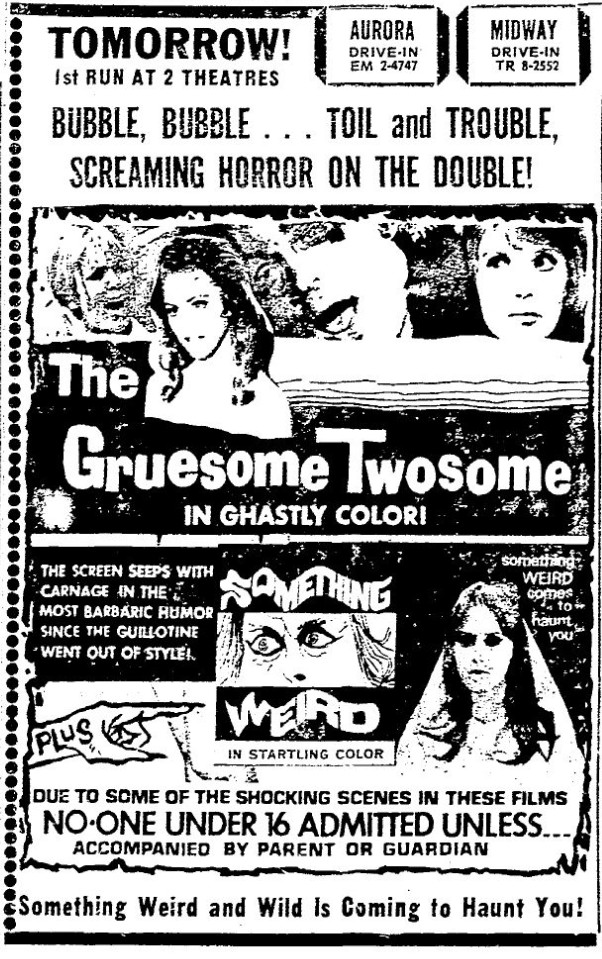
September 10, 1968 ad (Seattle)
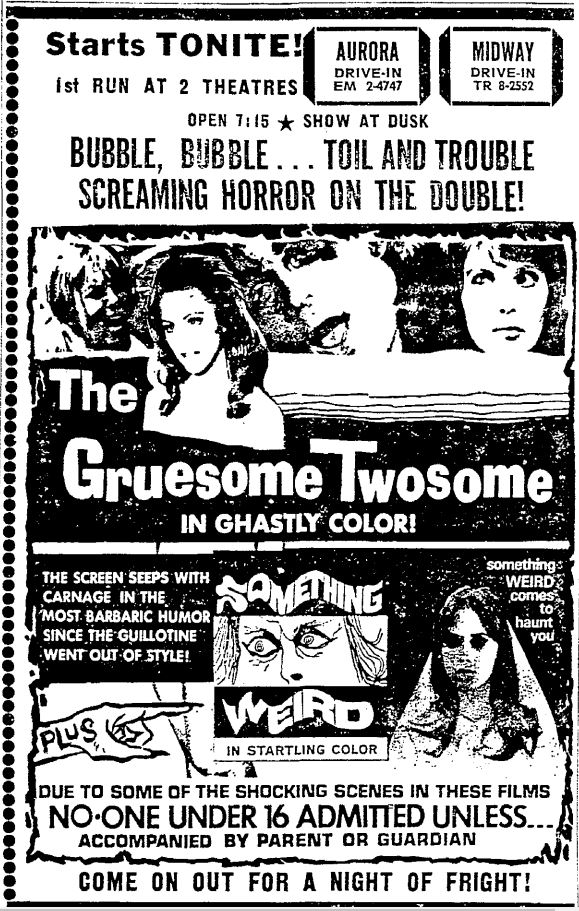
September 11, 1968 ad (Seattle)
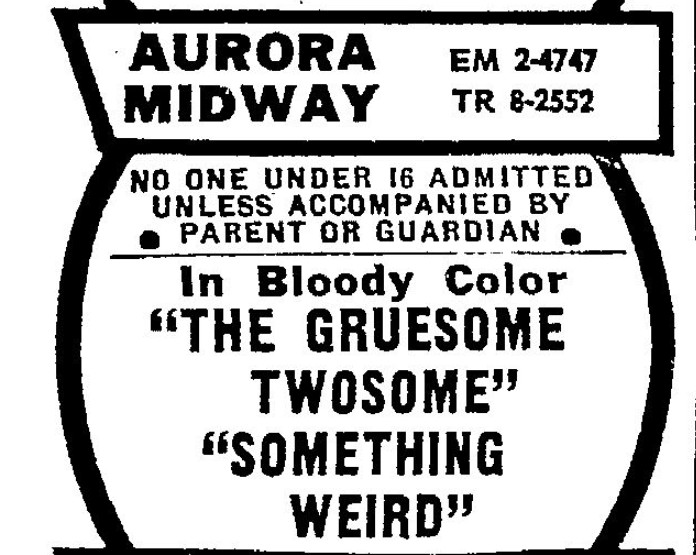
September 13, 1968 ad (Seattle)
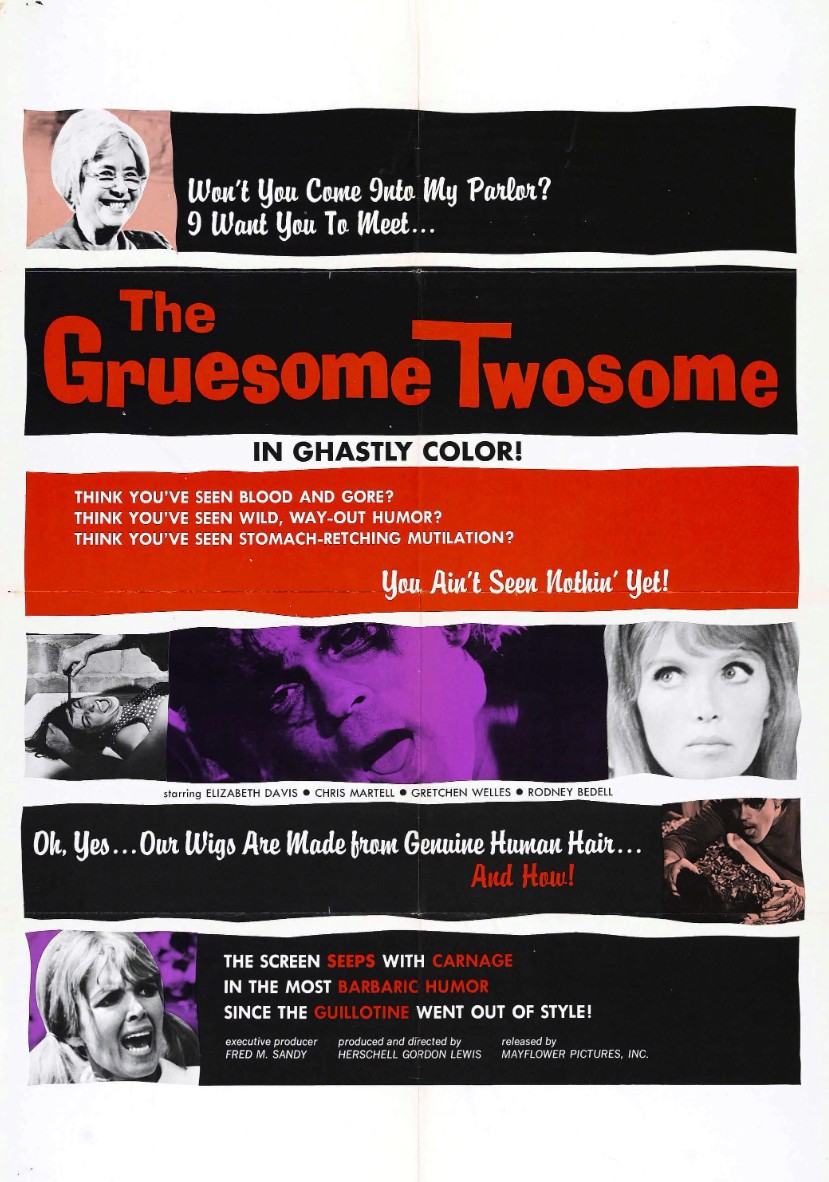
The Gruesome Twosome (1967) poster
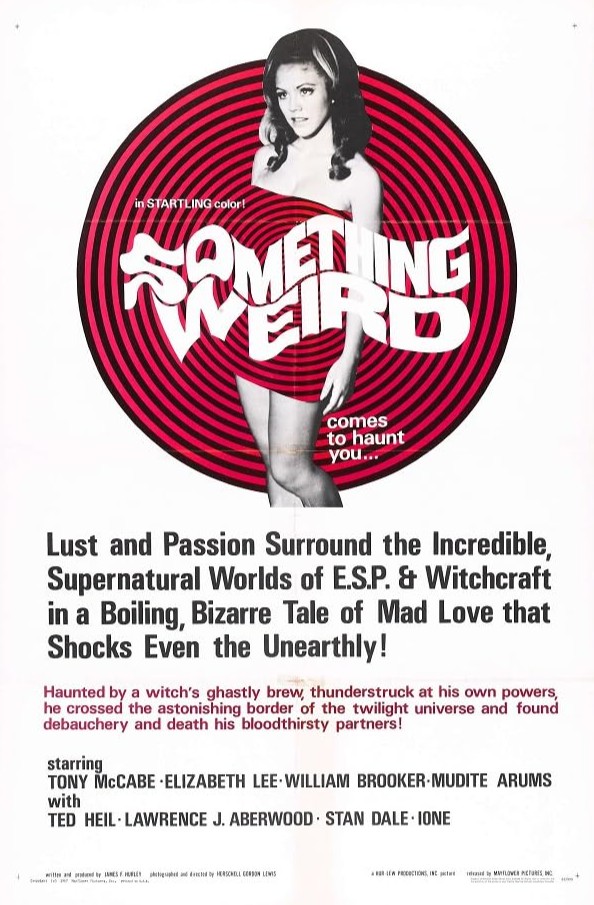
Something Weird (1967) poster
The Gruesome Twosome (1967) trailer
Buy "The Gruesome Twosome" (1967) bluray on Amazon (SPONSORED)
Buy "The Gruesome Twosome" (1967) DVD on Amazon (SPONSORED)
Something Weird (1967) trailer
Buy "Something Weird" (1967) DVD on Amazon (SPONSORED)
