This is a collection of media from the initial runs of "Psych-Out" and "The Wild Racers" (1968) in the Pacific Northwest.
Click on images for larger versions.
Psych-Out (1968)
"Psych-Out" (1968), directed by Richard Rush, is an immersive dive into the countercultural vortex of late-’60s San Francisco—a vivid reflection of an era intoxicated with its own freedom and fragmentation. The film is set in the Haight-Ashbury district, and its soul pulses with psychedelia, hallucination, and the electric rebellion of a generation testing the boundaries of self-expression and sanity.
At its center is a young deaf runaway navigating the kaleidoscopic underground of the hippie movement. Through her eyes, we explore the technicolor swirl of art, music, and free love, but also the undercurrents of exploitation and ideological decay. The film doesn't simply celebrate the flower child ethos—it probes it. Rush crafts a hallucinatory narrative that at times dissolves into disorientation, mirroring the altered states his characters chase.
Jack Nicholson leads a cast that blends charisma with unease, portraying seekers and drifters who are as lost as they are liberated. The dialogue often walks a fine line between enlightenment and absurdity, and the film’s experimental visuals—including time-lapse sequences, optical distortions, and sonic overlays—contribute to a sensory overload that borders on the surreal. Yet within this visual cacophony lies a quiet critique: beneath the idealism, Rush hints at a raw and untamed psychological wilderness.
"Psych-Out" refuses to romanticize the counterculture without also exposing its cracks. It’s a cinematic hallucination with one eye open—a collision of idealism and confusion that ends not with resolution, but a lingering echo of disillusionment. What’s most impressive is how the film makes its themes felt rather than spoken, letting chaos do the talking. It’s less a plot-driven drama than an atmosphere—a mood piece that paints both the highs and the haunting lows of the psychedelic revolution.
Director: Richard Rush
Writers: E. Hunter Willett, Betty Ulius, Betty Tusher
Stars: Susan Strasberg, Dean Stockwell, Jack Nicholson
Buy "Psych-Out" (1968) bluray on Amazon (SPONSORED)
Buy "Psych-Out" (1968) DVD on Amazon (SPONSORED)
The Wild Racers (1968)
"The Wild Racers" (1968), directed by Daniel Haller with uncredited contributions from Roger Corman, is a kinetic, globe-trotting meditation on ambition, speed, and emotional detachment, wrapped in the guise of a racing drama. At first glance, it appears to be a straightforward tale of a young American driver breaking into the European Grand Prix circuit, but beneath the roar of engines and the flash of victory lies a surprisingly introspective and stylized film that toys with narrative convention.
The film’s protagonist is a man in motion—restless, impulsive, and emotionally elusive. His journey through the racing world is marked not just by competition, but by a string of fleeting relationships and existential drift. The editing is rapid-fire, with few shots lingering longer than a breath, creating a rhythm that mimics the adrenaline of the racetrack while also evoking a sense of dislocation. Dialogue is sparse and often replaced by voiceover, lending the film a dreamlike, almost poetic quality that feels more European art house than American B-movie.
Visually, "The Wild Racers" is ambitious. Shot across multiple countries, often without permits, it captures the texture of European cities and racetracks with a raw immediacy. Cinematographer Néstor Almendros, who would later become a major figure in world cinema, brings a naturalistic elegance to the film’s chaotic production. His work here is a study in improvisation and intuition, elevating the film’s aesthetic beyond its modest budget.
Though the plot is thin and occasionally veers into melodrama, the film’s real focus is mood and motion. It’s a portrait of a man chasing something he can’t quite name—success, love, identity—and finding that speed alone won’t deliver clarity. The film’s fragmented style and refusal to offer easy resolutions make it feel more like a cinematic fever dream than a conventional sports drama.
"The Wild Racers" may not have achieved commercial success or critical acclaim upon release, but its experimental spirit and visual daring have earned it a cult reputation. It’s a film that races past convention, leaving behind a trail of questions rather than answers.
Directors: Daniel Haller, Roger Corman
Writer: Max House
StarsL Fabian, Mimsy Farmer, Judy Cornwell
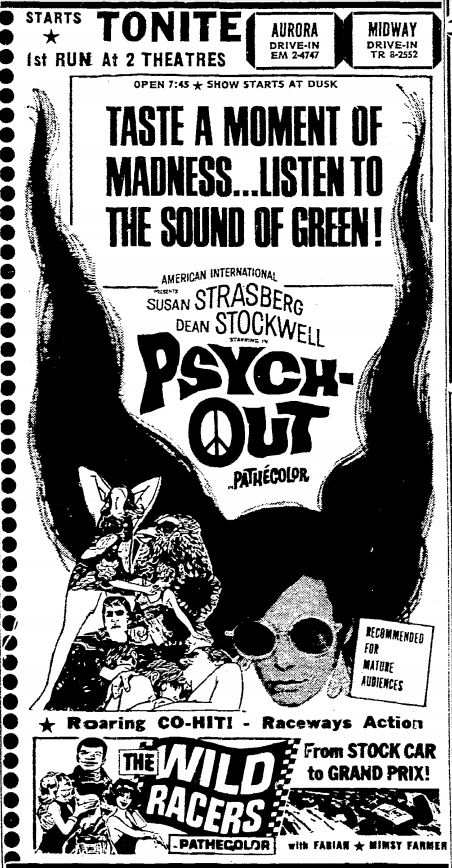
May 8, 1968 ad (Seattle)

May 7, 1968 ad (Seattle)
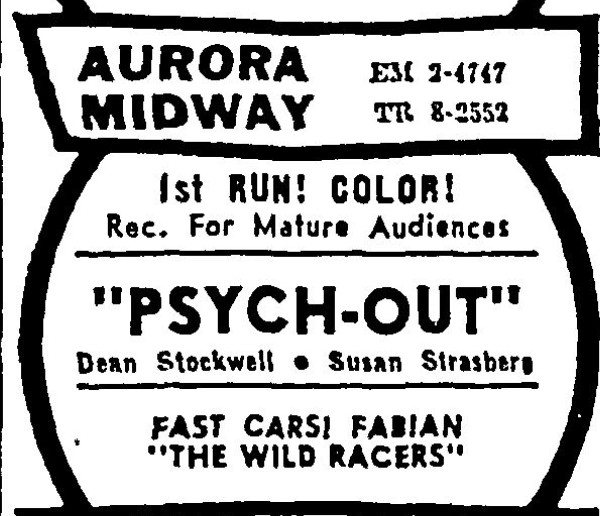
May 9, 1968 ad (Seattle)
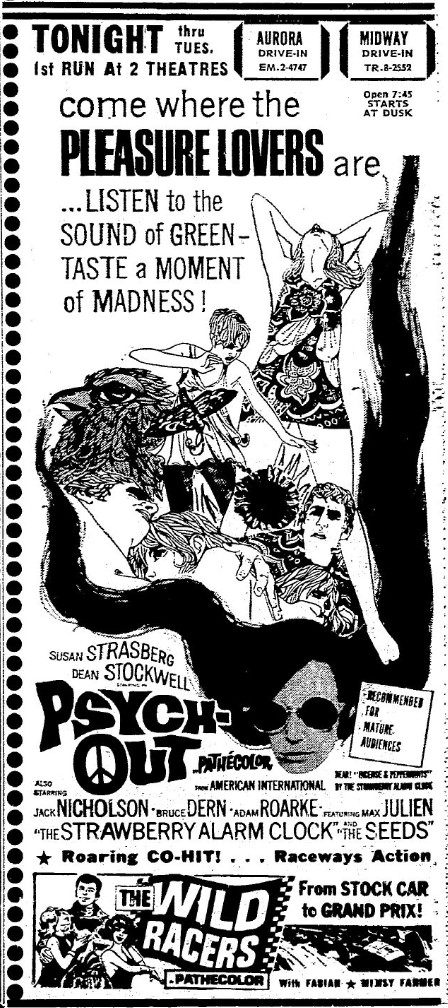
May 10, 1968 ad (Seattle)
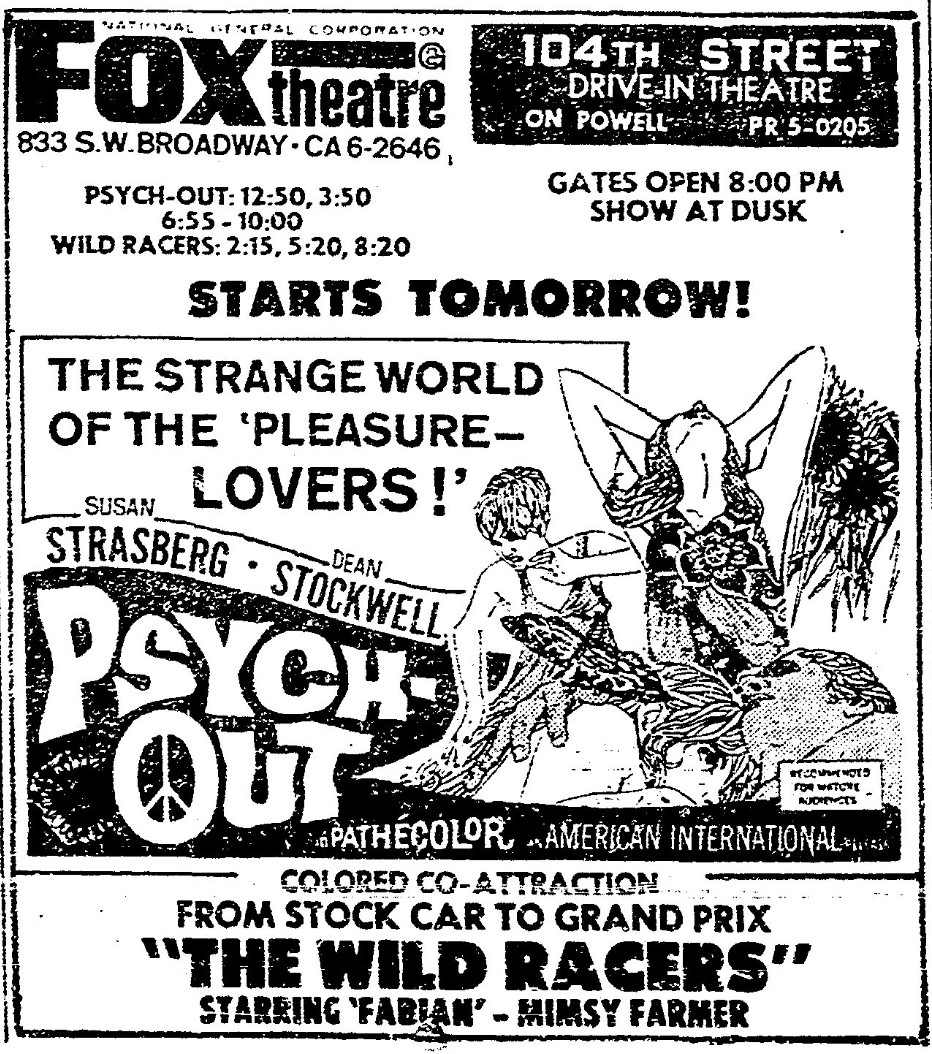
May 14, 1968 ad (Portland)
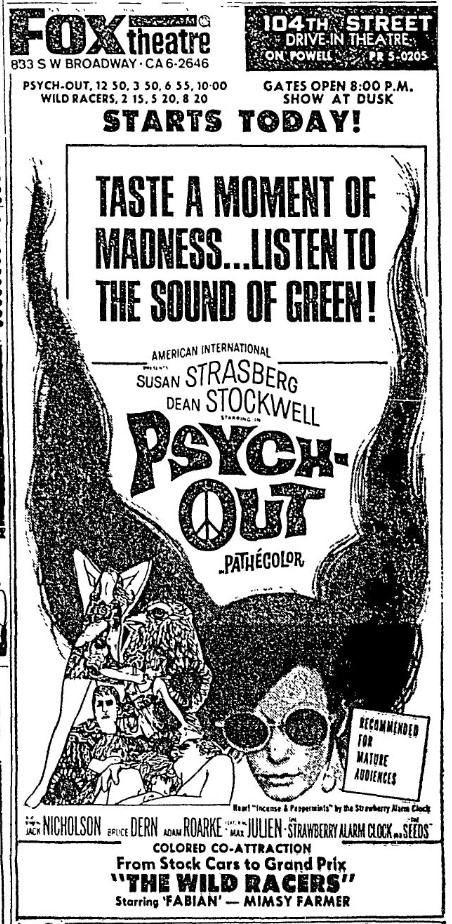
May 15, 1968 ad (Portland)
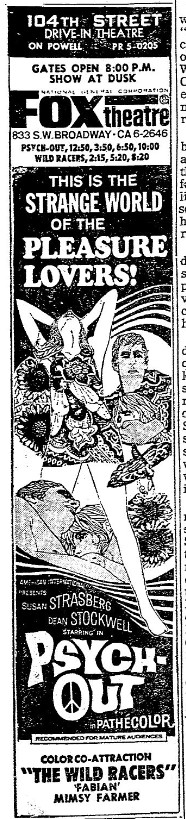
May 16, 1968 ad (Portland)
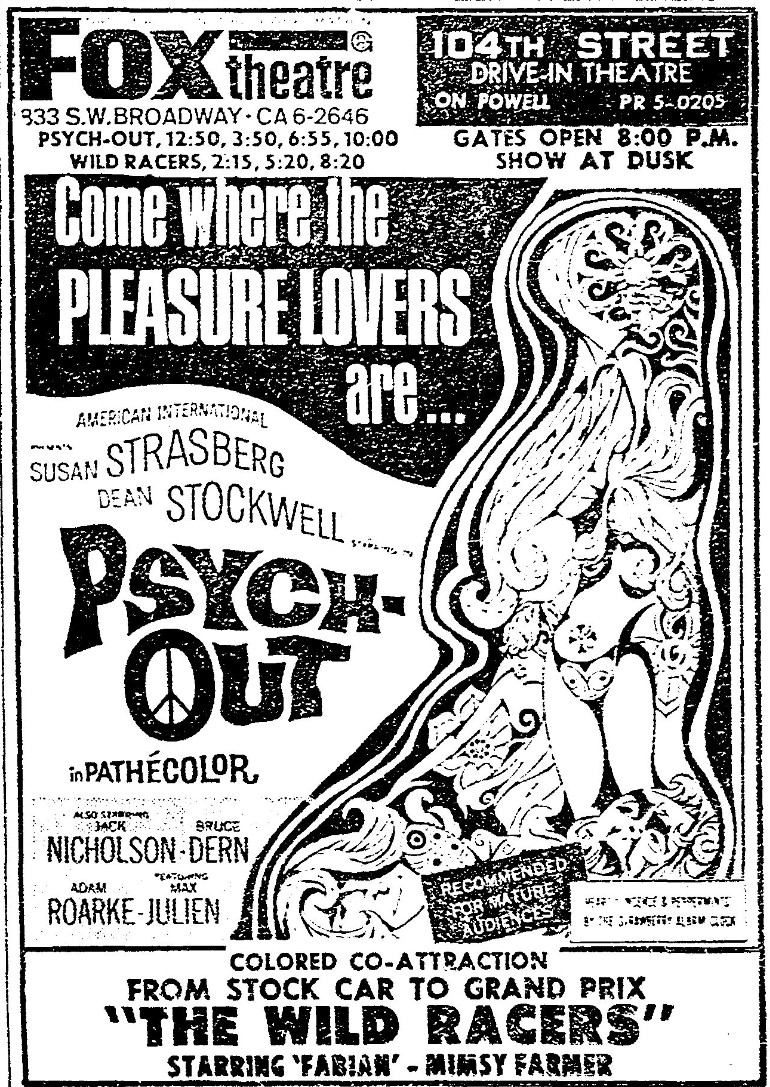
May 17, 1968 ad (Portland)
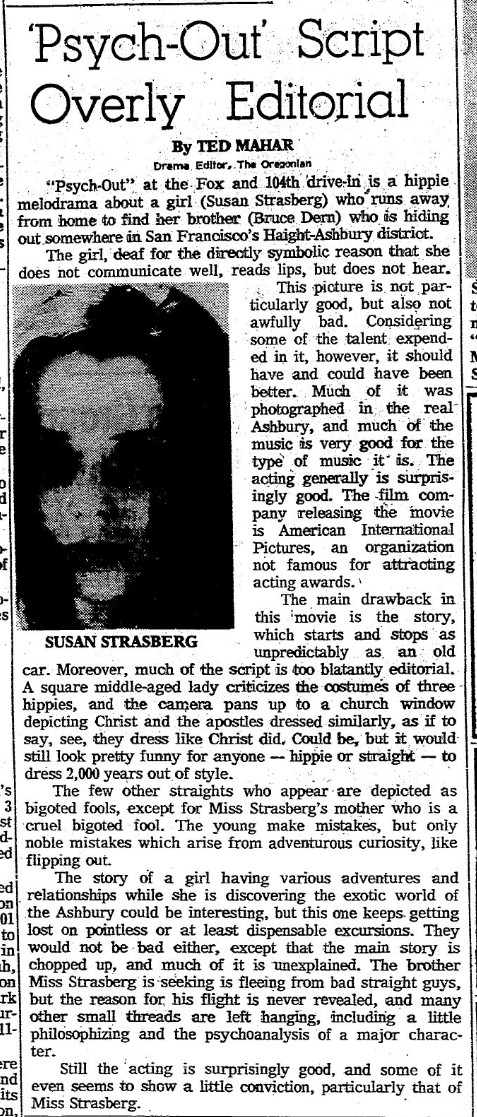
May 18, 1968 article (Portland)
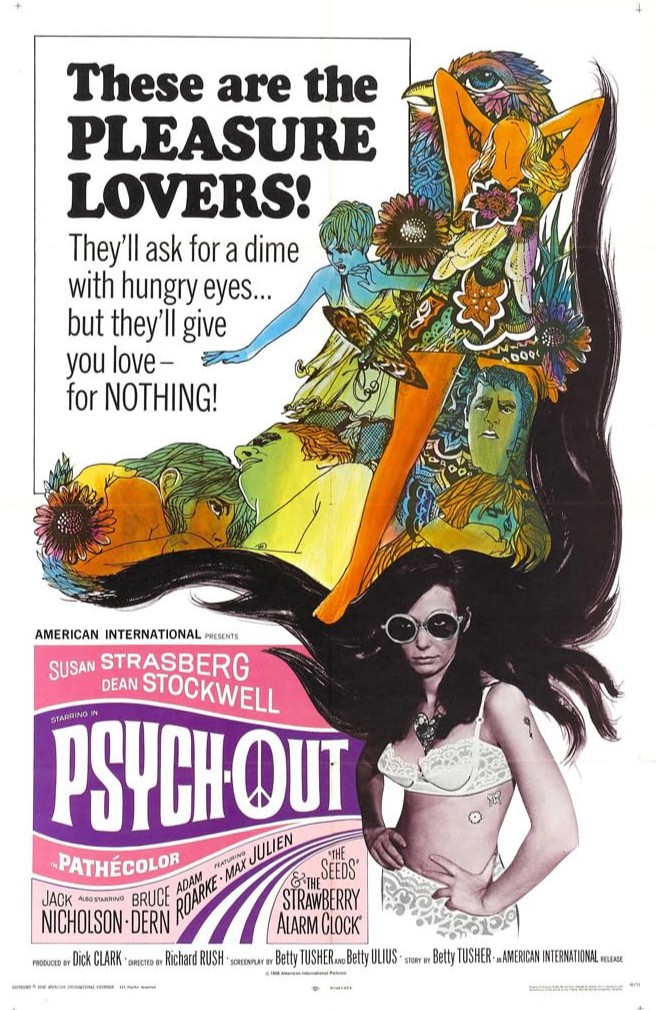
Psych-Out (1968) poster
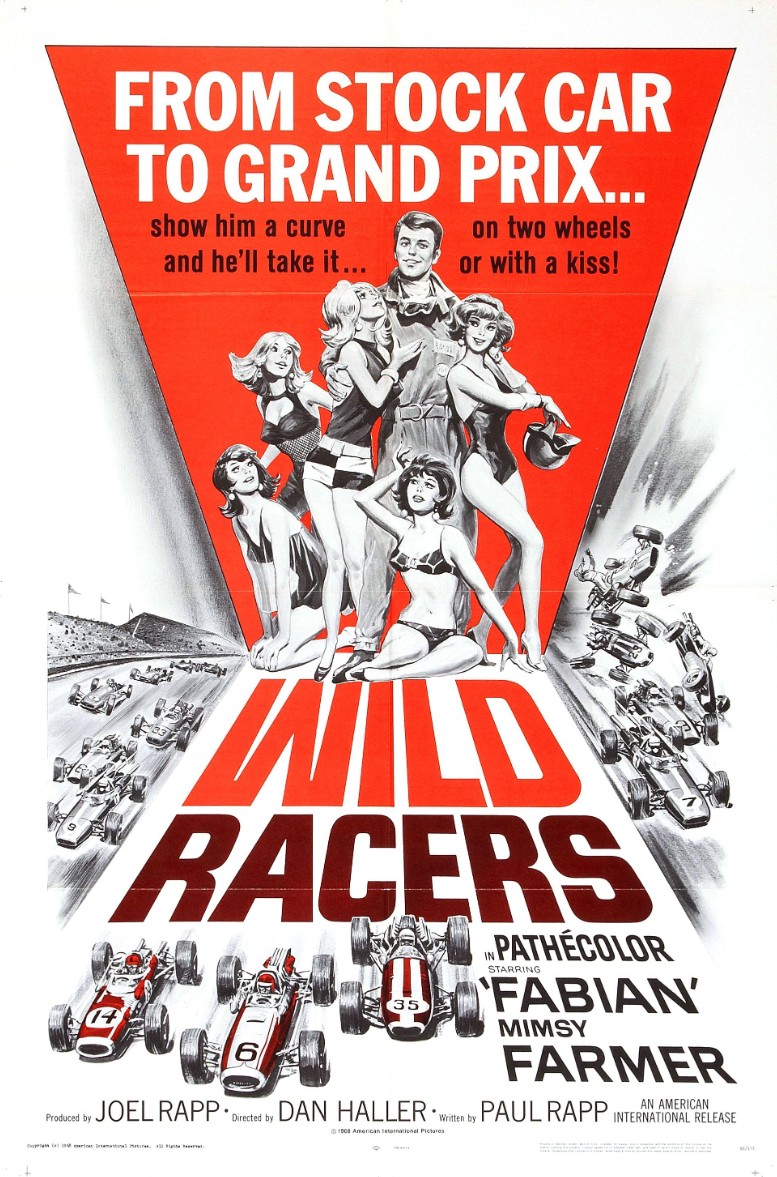
The Wild Racers (1968) poster
Psych-Out (1968) trailer
Buy "Psych-Out" (1968) bluray on Amazon (SPONSORED)
Buy "Psych-Out" (1968) DVD on Amazon (SPONSORED)
